Thursday, May 29, 2008

Attrition among new recruits...

The points that I mention here are from what I have seen in the real world corporate dynamics, heard about experiences from friends and few from the learnings and readings from various articles, journals and blogposts. The reasons that I mention below are mostly centered around those who have spent their time and energy in the industry (mostly IT/Tech/Tech Services/Engineering) from a range of one year to say four years after their graduation from an engineering school or a technical institute. Even few of the points apply to those who don a much higher number of years experience hat.

Attrition is a growing concern for almost all the firms across various sectors in different corners of the world but today the pain is felt more in India. This bruise gets highlighted more in an Indian context because as the economy is growing, the engines who are partners in this ride also need to deliver, but because of employee attrition few initiatives are put on the back burner. The HR managers are having a tough time finding a suitable replacement with required experience and ability, to fill up the vacancies created on account of exit of key employees.

Here in my post, I share few of my views as to why employees, especially new joinees leave the firm, a little after the embryonic stage of their job career cycle.

1. Company and personal goals clash: Many of the smart recruits in many firms these days are hired through campus placements in engineering schools during the pre-final year days. Placement talks are like major branding shows and each of the hiring firms tries to outshine others in the fray by attractive presentations in diverse formats. Company goals and visions are put forward to candidates and these tastes like the best recipes to whiz one's career. The message that is sent is: 'With the company's goals, all measures are taken for an employee's personal development also'. I am not denying the fact that there are companies who do orchestrate company's goals and employees' personal goals but the number is less. Come to the work place, the real world is not that rose-cheeked after one understands the underlying factors. This is completely out of phase, of WYWPIWYG assurance (what-you-were-promised-is-what-you-get). In short most of the cases of attrition thrive on the thread that firms place their priorities ahead of employees' goals, without understanding the employees' basic aspirations resulting in friction.
Although their HR depts claim that they have systems which ensure a smooth induction, training and deployment onto projects that isn't quite the case for everyone.
The full story is here.

2. Incorrect picture painted in campus placement talks: Many global firms work under different legal entities but under one global brand umbrella in India. To make things clear, lets take a fictitious firm 'Remain Connected Corp', which has under it many legal entities such as 'Remain Connected R&D Center', 'Remain Connected Software Services Center', 'Remain Connected Consulting Team', 'Remain Connected Technologies', etc. In most campus placements, 'Remain Connected' would go as a single team for hiring but the offer letters are delivered by the different entities under its canopy. To a campus recruit, who is not aware of all these internal corporate crosswords everything appears to be the same. But after working in the industry for a year or two, when s/he realizes that s/he was offered a cozen pill, looking for opportunities elsewhere is the most pragmatic option. So my practical suggestion to all the campus recruits, dig deep below the surface and ask questions to the HR manager of the hiring firm, talk to friends/seniors/relatives who understand under the skin of the scenario before you finally accept any job offers.

3. Opportunities available: The present economy has opened up the doors of opportunities. If a person is skilled, smart and is a store house of ideas, s/he is like an appetizing cake, waiting for the market to react. Present day progressive forward looking youth aspire to see their career advancement as well as improvement in his net earnings in the shortest possible time. Demand for smart talent is always there, so when an individual doesn't find his/her present place of work to offer a hastening atmosphere, there are other avenues to explore may be in another firm, a start-up or a similar place.
Thanks to his own ambition, and to the Indian outsourcing boom, he escaped. He gained admission to the best engineering school in India, then landed a job that he could hardly have dreamed of as a child: writing software for Oracle, the U.S. technology giant.

"I fell in love," he said, recalling his first visit to Oracle's campus in Bangalore.

But Jain's zest eventually fizzled under the repetitive rigors of the Indian back office. So he did what a parade of burned-out functionaries in Bangalore have begun doing: He quit outsourcing to create his own start-up - in his case, designing cellphone software that blocks calls from telemarketers.

4. Change in mindset, among individuals and society: Gone are the days, when one stuck to a job even though it was not satisfying, solely on grounds of monetary benefits. The present generation wants money, no doubt about that, but it's just not money, it has to be enwrapped with stimulating job assignments and responsibilities. More often than not, the most heard verdict of a majority of individuals is.
Besides, they soon learn, the job is not really about programming at all... One such dude sums up the average IT career path on a Pagalguy forum:

There is not much of a ladder is S/W industry as such. For most life is quite typical. One or two years in a company. Then a chance to go onsite and see some money. Then back home. Another 2 years and then one becomes an analyst and after 5-6 years, a manager. And your engineering branch is the last thing that would matter here.
Even parents and family members, do not evaluate much when they realize that their children are not very happy with their professions and wish to pursue something that is completely out-of-the-box and divergent to their present occupations. These parents stand as pillars supporting their individuals realize their dreams. I know of few people who have left their regular 9 to 5 jobs in tech firms to work full-time for a NGO, to practice as a full time photographer, to run a restaurant, etc. The attrition resulting from this is miniscule but it does happen, more so with individuals who realize that they had boarded an in-correct ship that would never reach the destinations they had sculpted in their mind.

5. Not much liking towards big names as before: Today grandiloquent brands in job market do not draw as much awe as it used to few years back. Big names are subtly occupying increasingly lower positions in a candidate's priority list. Individuals are perfectly fine working with small and mid tier firms because it's a known fact that sometimes the biggies cannot match the salaries offered by successful second-rung companies which functions to an extent on a start up blueprint. More so many big firms have even withdrawn ESOPs, which were the main draw a few years ago. In contrast smaller companies are able to offer profit-sharing plans, interesting projects and more responsibility at an early stage in the candidate's career. This is like a ready made dish for a candidate working in a big firm shrouded with global policies, indefinite processes, layers of politics, and most important lack of visibility in a big crowd.Rashmi Bansal makes a cogent post here.
In just 3 short years, the world has changed. When I wrote this column for rediff.com in June 2004, it was still a big deal to join one of the Big Five. Except, perhaps at an IIT.

With the rising aspirations of fresh grads the same jobs have lost their sheen. The net has to be spread wider and wider, to tier 2 and tier 3 colleges, which would not be on the recruitment map at all a couple of years ago.

At a lesser known college it is a matter of pride that 'Infosys picked up 6 students'. The feeling is that of having 'arrived'.

But next year when 60 join, and then 100, the same 'we are being recruited like alu and pyaaz' feeling sets in.
Bottom line is: 'Aapne kaam se maatlab raakho, yeh big brand maain rakha kya hai'.

6. Higher studies plan: A sizeable number of campus recruits move to the U.S. or other countries to pursue higher studies and explore more attractive career opportunities after working in the industry for a year or two after their graduation. They form a small pool of the attrition camp. Few go abroad for their Masters degree, few for their PhDs and few others stretch their stay in India to apply later for an MBA program. It's not that foreign lands are the only destinations, these days many prefer to go for a Masters program in the IISc, IITs, NITs, or even BITS in the engineering and tech stream and to the coveted IIMs and other top ranked B-Schools after clearing the CAT in the domain of business management. Even ISB with its global tag in business education along with many other private schools in India partnered with other western schools of Business Management is an irresistible destination for many who wish to put their lives on a fast track road. Every year just before the admission season, many managers wait dumbfounded to see how many of the ambitious wickets would fall.

7. Relationship between manager and employee: A smart manager is one who can understand the aspirations of his/her employee and can harness the true capabilities and potentialities to the last drop, brusquely pointing the areas of improvement among the team members. Now that appears as a picturesque and cheeky definition never to be realized in reality because most the IT related work in India is service and maintenance oriented, which in turn is purely dependent on margins and numbers. But more often than ever, a manager can't do justice to both numbers and fulfilling aspirations and finds him/her self in a Catch-22 situation. For some inflammation or misunderstanding arising at work, involving the manager and employee, mostly the bosses chalk up the tension to a personality clash. There is a tendency, according to management experts, to think that personality is the cause of organizational discord rather than perhaps an effect of it.
Ben Dattner, an associate at Dattner Consulting executive coaching firm, believes that personality conflict might be a symptom of a larger organizational issue. "When I work with my clients, I often try to get them to see how it is not just a conflict between two people. I try to get them to see that it is also potentially a conflict between two visions, two agendas, two constituencies or two visions for the future."
The most practiced remedy in this case by young employees is to nip off the problem at its root, just leave the job and find a place that suits to one's personal liking in most aspects. Quite a number of exits happen in many firms because of the above mentioned reason.

8. Team one works for: Fresh out of engineering schools, many graduates have a swelled head for being a product from a top school in India. This is very much human and expected behavioral pattern that this crowd aspires to be a part of best of the available work/assignments in any organization in the initial days of his/her career. But since most of the IT industry in India is doused in services and maintenance layer of the entire business cycle as stated in Point. 7, easy to follow processes are defined to streamline the execution segment with élan and efficiency. After doing the same work in repetitive cycles, it's no rocket science and even a normal graduate can tackle that in the most cost effective way without necessitating the presence of smart engineers who demand higher pay checks for the same job.

This air of exclusivity and clannishness lingers in the minds of many for the initial first two years. Unfortunately if they happen to belong to a team that is of a different clan/tribe than their's in many vistas, they connect with their friends and settle in zones that match their bandwidth. A sizeable number of exits in many firms fall under this category.

As I mentioned here, the points stated above are my personal views and are collected from various sources. This is definitely not intended on any organization, firm, group or for that matter anybody and everybody. This is an open post and if someone is willing to share more views on this topic, do blog and tag back, write and share your views.

Keep reading and remain connected.

Labels: , , , , , , , , , , , , , ,

Monday, February 11, 2008

Engineer 2008, to enquire, create and innovate...

Formerly known as KREC Surathkal, and now with the new name National Institute of Technology, Karnataka (NITK), this institute is one of the best places in India to spend the college days. Apart from being a top-notch engineering institute in India and ranked as one of the best schools in this nation for engineering talent, this college is a fun place to be in.

Situated in a secluded place, far away from the Mangalore city, this small hamlet of Surathkal has a picturesque beach which is just stone's throw distance from the college campus. The salt laden winds, the smell of fish on the highways near the campus, living on a shoe string budget, the road side tea stall @ Krishna, the clean surroundings of red bench on the beach and the lighthouse, all these make the life at this place for a period of four years, a never to forget experience in the lives of those who graduate from this esteemed institute.

NITK hosts, an annual technical fest, 'Engineer' each year and over the years it has grown not only in volumes but also has been a platform for some interesting discussion to celebrate the spirit of engineering. It also highlights, the impact the engineers can make to the society. Engineer 2007 was a well organized event, which brought together students from more than 120 colleges from within India and abroad. The symposium attracted the talent across India and also a gamut of sponsors with prize money worth Rs. 9 lakh.

The highlights of Engineer 2007 were video conferences with world-renowned scientists, including Bjarne Stroustrup, the creator of C++ and Prof. John C Mather, a Nobel laureate in Physics. The Last Word, a debate about Government Expenditure on Higher Education, saw many eminent personalities discussing and debating on very important topics and the how the engineering fraternity should take more responsible steps. Prof. Deepak Phatak, Subrao Nilekani Chair in KReSIT, IIT Bombay and Dr. Anil K Gupta, Executive Vice Chairperson, National Innovation Foundation were some of the chief speakers at this event.


A workshop on building underwater robots by IURS (the Indian Underwater Robotics Society), a hardware workshop by Ashish Derhgawen, a young IT student from New Delhi was one of the most featured workshops. There were many such events and open house discussions. Events like these opens up new avenues for discussion and research and adds new dimension in the thought process of graduates. I personally feel that an event of such proportion has many benefits: helps students to plan and organize as the entire show is managed by a students committee, it helps to meet students from varied backgrounds and share ideas, and also makes students realize that there is a big world to explore outside, rather than settling for a career in the regular IT and services industry that paints a rosy picture in the pre-placement talks.

I also feel that this is most apt time for the students to explore as there are ample opportunities on the fray, the market is healthy and needs young blood doused with energy, innovation, entrepreneurship and ideas. To support my point, at the previous year's competition, few of the featured contests, were Mushaca, where participants were invited to create original software applications that could benefit from the use of a three-degrees-of-freedom mouse (pioneered by Dr. Tim Poston and Srikanth MB, IISc Bangalore) and Mock Stock, an online stock exchange simulation.

I feel that this year’s fest, Engineer 2008 will be even better, bigger and loftier., and all those who can make there, just rush to Surathkal, to Think, Create and Engineer. More details here..

Keep reading and remain connected.

(If you watched the video clipping, there was one line that I liked the most: 'The qualification if you wish to be innovative is not that you become front benchers but become back benchers'.)

Labels: , , , , , , ,

Friday, January 18, 2008

Rush Rush to Head Start...

The Indian economy is on an upturn mode and there is lot of action and acceleration in various industries across varied segments. On a personal front, what I like is there are many people, at least the number is exploding who want to shake up the world of business and technology, driving away from serving in companies and starting something on their own. So if you are one such person or even otherwise someone who likes technology, business, ideas and innovation, make sure that you don't miss this Big Bang event Head Start happening from the 18th-20th Jan'08 at Indian Institute of Science, Bangalore. Well if you are taking the auto rickshaw, to reach this place, tell the autowala Tata Institute as that's how this Mecca of research and technology is known to the common people.

Head Start is a showcase of most exciting products and technology in India, of course with a new color, goal, and impact and definitely has a broader goal and vision.


So what is that what makes this event exceptional and prodigious? In most of the existing showcase events, we often end up meeting people with ideas, VCs and entrepreneurs. That's definitely an Olympian concept. But at, Head Start, it has all these and also covers the entire innovation lifecycle in one place and under one umbrella. This means the participation is holistic from all the players in the innovation lifecycle: academicians, researchers, entrepreneurs, solution architects, marketers, large companies, technology geeks, venture capitalists and customers, etc. The synergy among all these discrete communities to discuss and debate is one of the focal spark points to accelerate the pace of innovation in India. There are many topics to be discussed across domains such as:

• Consumer Services
• Mobility & Communications
• Silicon & Embedded Systems
• Enterprise Applications and Development Tools

The Agenda tab on the main page of the site is a good place to get a bird's eye view. Do have a look and participate in this exhilarating event.

Have fun.

Keep reading and remain connected.

Labels: , , , , , , ,

Monday, January 07, 2008

An Unsung Hero : Girish Bharadwaj...

In India, when we browse the newspapers these days, we read volumes about the story of 'digital divide' and how many of the telecom vendors and other entities are attempting to bridge this gap. To me, to be connected with the outside world, comes in the second level of requirement, after the core essentials for the proper functioning of a developing society are met.

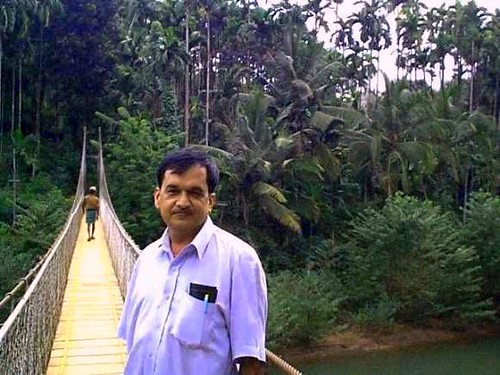
The luxuriant Western Ghats kissing the borders of Karnataka and Kerala are a fascinating series of greenery dotted with hills and valleys, simple people, countless rivers and loads of freshness. Traveling across this stretch in the Indian Railways is the best way to soak oneself with the flourishing vegetation. To an occasional visitor, all these appear charming, a perfect way to break free from the randomness of city life. But come rainy season, this region is completely cut from the outside world, a place where people use boats or coracles in their daily lives to commute and to transport kids to the schools across the water bodies.

Living in cities and towns, we are tuned to getting all the facilities to reach our offices, schools, banks or for that matter any destination at any time of the day. Now think of a scenario in a village where the boats are the only savoir, and with the overflowing river during the monsoons, most boatmen are reluctant to ferry their boats. Life would come to a standstill, kids can't go to schools in time, pregnant ladies needing medication in the middle of the night can't be transported to the nearby hospitals and the problem list becomes endless.

But there is this unsung hero who with his engineering skills and humanistic activities has brought smiles and cheer in the faces of many people. This is Girish Bharadwaj, who hails from a small village Arambur, in Aletty district near Sullia town on the western slopes of Kodagu. Born in Mangalore in 1950, this virtuoso received his formal education from P.E.S. College of Engineering in Mandya near Bangalore. He learnt the classical techniques in Mechanical Engineering, during the 1970's, a time when not much stress was laid on experimentation but rather on the application part of it. During those days, getting a job was considered a remarkable achievement, and Girish took up a part time job while running Ayas Shilpa (sculpture in steel), a small fabrication unit in Sullia town.

It was in 1988, that Girish's career took a dramatic turn, when few people from his native approached him and requested him to build a bridge. Girish replied that since he was Mechanical Engineer and was not at all adept in Civil Engineering and construction related designs, he was not qualified for the assignment. But persistence, tenacity and the people's faith in him, triggered an unusual fire within him and he started studying about bridges. He consulted the technical faculty at two of the top technical institutions in India, National Institute of Technology, Surathkal and Indian Institute of Technology, Chennai and thus started his journey.

Today at the age of 58, Girish is the proud architect and constructor of close to 68 bridges in the deep hinterland, the average length of most bridges being 70 to 80 meters. The skeptics who had the impression that bridges, cannot stand without the pillars in difficult terrain, are speechless today with his marvelous creations, the suspension bridges.

bharadwaj_1

I know Girish for a while now and after interacting with him, he shared with me few other facets of his artistry.

Initially big trees were used as pylons, if those were available at the right place as in case of Kodagu district. The trees were the perfect fits, when the bridges stretched from 10 to 30 meters. Concrete pylons are now preferred for longer stretches because of their assured long life. The hanging floor element is quite stable supported by anchors and transoms. On both sides of the bridge, PVC coated chain-link fencing is erected till waist level. Over the years, the bridges have seen many conceptions and engineering innovations.

Girish is supported in his work by a team of 36 members, of which 18 perform the core design and implementation tasks. Since there is no other organized body in India, which is consistently building hanging bridges at a low cost, with uncompromising importance to safety and quality, Girish has to yield to pressures now and then. I learnt that very recently he has got invitations from Srinagar in Jammu and Kashmir and Bhavnagar in Gujarat to undertake some new initiatives in those lands.

Because of various reasons such as distance to commute from Karnataka and to adjust in these new lands with different climatic conditions, lack of a skilled team to backup his core team members who are getting old, Girish is more than willing to share his knowledge and know-how's to interested people. He told me that all he needed were a dedicated engineer and a bunch of smart working boys and he would accompany and guide them till the completion of two or three bridges in a new region. Thereafter, the new team can carry on this task all by itself.

Girish, a father himself never pressurized his own children to carry on this tradition, and he is scouting for people interested to perfect the craft and utilize this workmanship for the benefit of the people and society. Although Girish, has not been advertised in the print and the online media much, he has found himself admirers from far and wide like Sri Lanka, Switzerland, Cambodia, etc.

Girish's people-based approach towards his work has always attracted considerable local support and it is very practical. When construction is in progress, his entire team, lives in small tents constructed on the river bed. They share the work and the food, concentrating till the project gets over. Girish recently completed a project in the naxalite terror afflicted, Warangal district in a placed called Laknawaram in Andhra Pradesh. He told me that, at night the common villagers used to come and share the tent with his entire team, providing the much needed security more out of thankfulness and appreciation, rather than his personal petition.

Trifle makes perfection but perfection is not a trifle, these words of wisdom apply to this master artisan who has lived his life bringing goodwill to millions of hearts. A rare individual to find in this bribe hungry bureaucratic world, not bothered about the felicitations, and all that drives him in his selfless endeavor is the gratitude and the warm blessings of the people.

Girish Bharadwaj's story is informative for those uninformed of India's social dynamics and wish to bring about a change by engaging in action-less dialogues and debates in television channels. Much of the exclusive economic growth and development is centered around urban areas and most of us in these concrete jungles, do not have enough time and energy for making a change in the bowels of India. But that hasn't stopped few humble folks from exploring ideas and gathering a core of dedicated people around their passion. Isn't that a miracle ?

Keep reading and remain connected.

(Note: Incase any reader is interested to interact with Girish and wish to learn more about his work, do drop me an email, (its there on my profile) to collect the contact and email details. Doing this to avoid misuse of the contact number and email account with unwanted calls and spam mails.)

Labels: , , , , , , , , , ,

Thursday, May 31, 2007

'Super 30' rocks again in IIT JEE'2007

Yesterday, the results of the coveted and one of the most challenging entrance tests, IIT Joint Entrance Examination' 2007 were declared. This year, 2,43,029 candidates wrote the entrance test, out of which 7,200 candidates are eligible to seek admission to 5537 seats in IITs at Mumbai, Delhi, Guwahati, Kanpur, Kharagpur, Chennai and Roorkee and the other two institutions in Varanasi and Dhanbad. This year 54,025 girls wrote the entrance test and 587 of them have qualified.

The results of this pattern come every year, but the results are something, which offer complete satisfaction having made to one of the best schools in the world. Most of the selected students come from middle-class or upper middle-class backgrounds and prepare for the exams through private coaching and correspondence course material from groups like Brilliant Tutorials, FIITJEE, etc. Cost factor being a prime concern and access to good study material another important factor to consider, students from rural or semi-urban are generally not able to match with those students from towns and cities. This point assumes that most of the students who crack the IIT JEE undergo some sort of training or mentorship other than the regular course material used at +2 level. To put a halt to the practice of more than two attempts to make into the IIT's, thus indirectly discouraging the mushrooming of private tuition schools, IIT examination board has introduced the new rule that allows an aspirant a maximum of two attempts to take this test.

Whatever may be the case, in the past few years, a small group of desperately poor, talented students have made it into the IITs. This year also 'Super 30', a grooming school located in Patna, the capital of Bihar, one of India's least developed states in India will be sending 28 bright chaps to the IITs and the remaining two, both Dalits are hopeful of sailing through once the results of SC/ST aspirants are out.

What makes 'Super 30' special is this. Anand Kumar, a local mathematician, and Abhayanand, Patna's Deputy Director General of Police and a lover of physics, founded the school in 2003 to help promising locals get ahead in the caste-based society. The name of the group is 'Super 30' as both Anand and Abhay scour Bihar's least privileged communities for 30 bright students to coach them for the exam, providing free lessons and housing. The results from this intelligent group speak it all. 18 of them cracked the test in 2003. In 2004, 22 of the 30 came out with flying colors. The number of successful candidates increased to 26 in 2005 and 28 in 2006.
The 'Super 30' heroes this year include Pranav Prince whose mother works as a tailor to support the family. There are also a nurse's son and an FCI godown watchman's son. "Hard work + 'josh' = success," formulated Abhishek Kumar, another 'Super 30' star who is ranked 327th in the IIT-JEE this year.
Reading this news, it reminded me of one of my batch mates, Sudhanshu from my graduation school days. Sudhanshu hailed from a small town in Bihar. He was called 'Pondy' in my batch, a sort of introvert who in spite of a tight schedule and strict regime with the course program was often lost in his world, engrossed in solving problems in Mathematics and working out puzzles most of the time. Four years back when we left campus, he had a high paying job in a multi-national firm. But the sophistication, worldliness and chamaak dhamaak of corporate world, couldn't hold back his true inherent aptitude for long. He ditched his job within one year and took to teaching Mathematics and helping students to crack IIT.

Dost, I am proud of you.

Also why I felt good when I read this news is because of the fact that, today education is a trump card for those from the lower [both in terms of economy and information] strata of the society to march with the new world, kaadam se kaadam milake. Moreso results like these spread the awareness among the rural populace that even they can make a mark. To give an example, Santosh Kumar, was one of the products from the 2006 batch of 'Super 30', and his story is classic example of never-give-up and dream for the best in the world and work towards it. Santosh is from Dumari, a village in the Bihata district, about 22 miles from Patna. Nearly all in the village of 3,000 residents scratch out a meagre living as farmers. Santosh after attending the village school used to sell vegetables the family cultivated in a nearby market town.
Santosh saw that "education was the only way out of poverty," he says. At first, he planned to study so he could become an officer in the Indian civil service. After high school, he enrolled in the Patna College of Commerce, and then he heard about the IITs and the Super 30. "I went straightaway to Anand Kumar and told him: 'I dream of IIT, but I have no money.' He gave me his test, and I came second in the class. [He] let me into his Super 30 -- free," Santosh recalls.
In the IIT JEE'2006, his efforts paid off, when he won a coveted seat at IIT Kharagpur. He ranked 3,537 out of the 5,000 students chosen.

Early this year, Norika Fujiwara, a former Japanese beauty queen and actress, made a documentary film on 'Super 30' for its innovative and successful attempt to send poor children to India's top Engineering Colleges.

Also, this post was of special interest to me, as someone in my own family had a more low-toned version of what few chaps had undergone as mentioned above. Close to 26, years ago my father's younger brother had topped in his Bachelor's Degree at IIT Kharagpur and was awarded the Gold Medal in Dept of Electrical Engineering. He had got scholarships to make to the top schools in the US for his Masters Program, but the family didn’t have enough funds to sponsor his air-tickets then. Somehow the finance part was taken care through loans. My uncle later completed his Masters and then his Ph.d and today heads and operates one the best Electrical Engineering Company with offices at various locations in the US and in Canada.

As in the words of Bubli the movie in "Bunty Aur Babli",
chote chote sheroin se
khaali boore dopehroin se
hum to jhola uthake chale


Keep reading and remain connected.

Labels: , , , , ,