Monday, December 22, 2008

Poppins...

How many times did my uncle, tell me the story of how the universe was formed. With his index finger he would draw the line of a rainbow through the air and tell tales about it's formation in the aftermath of light rainfall, with the sun still shining bright. I still remember, I was in standard two or three then and whenever my uncle realized that concepts were not settling distinctly in my mind, he would pull an edition of Britannica encyclopedia from the book rack and show me the details.

Well, he was to me, my Poppins uncle. I used to visit his house on Saturdays after school, (we used to have half day school on Saturdays) and return back on Sunday night, so that the regular school routine from Monday was not neglected. Every time when I used to leave his place, on a Sunday night, it was a sad faced me, tears rolling down my eyes and a tantrum-filled goodbye. This man, in his late 50s then was a member of the teaching faculty in one of well known technical institutes in India, National Institute of Technology, Rourkela.

I always felt the separation anxiety while leaving on Sunday nights for a number of reasons. First and foremost was, Monday means back to school, getting streamlined for the regular monotonous life again. Other than that, those two days spent in the college campus were literally doses of middle class pampered treatment. Those who have seen any of the IITs or National Institute of Technology or IISc campus, can appreciate better, when I saw the campus is vast, open, lush green, widespread and Brobdingnagian. These are mini townships in themselves and the staff quarters are generally situated in one corner of the unit. Staff quarters have open space and the garden within each quarter's boundary provided the perfect pitch for a game of cricket, cycling, and just run around among the guava, mango and litchi trees playing hide and seek. At evenings, rush to the college campus open-air theater and watch a movie, (am sure this is sort of a ritual in every good campus, of screening movies on weekends at night) and fall asleep in my uncle’s lap half way through the movie.

More than all these, he was one who taught me to write perfectly within the four lines in my notebook to master cursive writing. He was never a teacher to me, just that I felt it more fun and interesting to do something when he asked me to do so. He was the one who instilled in me the pleasure of reading since I was a kid, grew up with Enid Blyton, Hardy Boys books, Tintin and Amar Chitra Katha comics, National Geographic Society magazines, etc.

My downhearted and blue departure from his place on a Sunday night was always buoyed up by a simple gift from my uncle every time. Yes, it's every time. A pack of Poppins and a bar of 5-Star chocolate. So don't you feel, it was pampering, when I had to request my parents many a times to get this share of candies during a 5 day week's time. Fullto masti, reading comics, encyclopedia and no school books, cycling, watching movie in the college campus (cable TV by then was not popular), visiting engineering labs full of boilers and machines such as lathes, drilling machine, etc and last but not the least a pack containing 10 differently colored, button shaped candies. What more do you need?

So that was Poppins uncle to me and to this day, I call him by the same name, though both of us have grown in the past 19 years or so. A couple of weeks back when I saw him at a family function after a long long gap, found that he had grown old, could see wrinkles on his face, hair gone white and he had adorned all the symbols of aging. That's natural, but what I liked about him is that still he is youthful at heart.

True to his keen appreciation for books and keeping in mind the childhood days, he had gifted my elder brother, a book on the eve of his marriage. I even overheard what he transpired to my brother when he handed over the gift in the crowd of guests who had gathered for the reception party.

'I am really proud of you and the kind of individual you have grown up to. Work hard, be smart and make sure that you have a nice life ahead with your partner for life. I also recommend you to open this pack and there is something special inside this. Make sure to read 'this' when you settle back at Chicago'.

Later on, when my brother opened the pack, it was this, a book. Just shows how thoughtful someone can be. Perfect cursive writing.
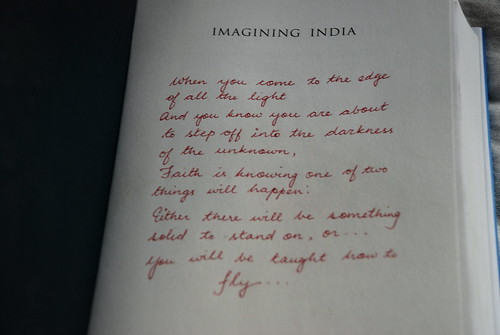
Imagining India

And there was another small pack, and it had 20 packs of Poppins. A small note was there saying that it was for us brothers. It said 'Even today, the taste of orange, lemon, strawberry, black currant or the pineapple flavored sugary buttons of Poppins is the same, what it was when you were kids.'

Still the words keep resonating in my mind.

Because we live in an age of gross accumulation, flash and displayism. Anything big and showy when it comes to gifting draws more attention. Think 'Bada Hai Toh Behtar Hai', it's the size, the bigness that matters AD from Videocon. But still there are things that generate more compassion and warm sensitivity when it comes to gifting. All it needs to select one of those are attitude, an attitude to embrace the good things of life and in a wordless way of telling someone how much they mean to you or what you think of him/her/them.

This brings to my mind, an unforgettable gift, that one of my friends, a retired newsman and reporter, GV Krishnan had given his friend, Kini. Can you make a wild guess what was that? It was a B2B gift. I know your mind would have thought Business-2-Business for the word B2B, but it stands for Blog-2-Blog. It's the tale of two friends who are now in two different corners of the world but started their career in reporting decades back traveling round the globe.

Kini and I had lost touch with each other when we were still young, wild and experimenting in London. When reconnected, we found ourselves wizened by age, hassles of living, and, in Kini's case, by an incurable ailment. Our re-connect dates back to a mail from him well over a year back, informing me of a change of address. He had shifted base from London (where he had spent four decades) to a chalet bungalow in Herne Bay, Kent - "a geriatric land where one is more likely to see dear old ones scooting around on electric-scooters than young lads on noisy motorbikes". The real message was in Kini's sign-off line that read - 'Uncertainty and hope fills my life at present'.

The complete B2B series is here. Check those, perfect tapestry with words.

Now since this is the time of the year, when people exchange gifts, what gift are you giving me? A pack of Poppins, 'Doooin kya'


Keep reading and remain connected.

Labels: , , , , , , , , , ,

Tuesday, July 08, 2008

Lucknow 76...

Few months back, Dr.BD had made a post on Lucknow, depicting few panoramas of the city sitting in a roof top restaurant relishing gorgeous food.

But why did this topic come into picture, the connecting chord is 'Lucknow', a city that I have never visited but have read about it and also heard lots about from my room-mate who graduated from IIM Lucknow. Last weekend, I was at Alliance Francaise de Bangalore, to watch a play titled 'Lucknow 76'.

The plot of the play was based on politics and history, shifting between two time frames of 1876 and 1976 looking at Lucknow city through the eyes of the common man. 1876 was a milestone for the Britishers, as that was the year, when Queen Victoria took over the command from the East India Company. 1976 was also significant in history because during that time, the once proud democracy, India was under the clutches of tin pot dictator, Indira Gandhi who had declared a state of Emergency as the Prime Minister of the nation.

So that reasons out for the numeral '76' in the title of the play.

But then why 'Lucknow' and why not 'Delhi' or 'Bombay' or 'Calcutta' or 'Madras' or 'Bangalore'. Because the director and playwright of the play, Abhishek Majumdar (AM) had spent some part of his childhood in this city. During AM's visits to Lucknow, his grand uncle, a scholar of history and geology had inundated his mind with tales and chronicles about the city from an old bungalow.

Now back to the play and the players on the stage.

The stage was a raised platform, bare minimal in terms of setting. A collage carpet dressed the entire floor. A ziz-zag geometrically-shaped stool, an artistically designed bench on one corner and few cushions were all the props used during the various scenes.

The play began with the entire cast of actors on stage firing words arbitrarily, and this state of confusion continued until two characters working in a press chisel in. Soon an old madam editor, of the press enters and they discuss about the sabotage of press and free speech during the 1976 emergency.

The sequence of the scenes in the plot follows a pattern like they do in these aerobic classes, one step back and then one step front. So one scene from 1876 and then one from 1976 and the flow continues. You get me right.

A greater part of the play covered, the 1876 era and it was masterly role-played. The three lead actors for this part were a Muslim revolutionary, a Brahmin Compounder and a brown British madam. Now how can a British madam be brown, that's because her father, a Brit and a general on duty in India had married an Indian woman. As the play rewinds to Victorian India, fervent and fiery debates rise about nation and ruler royalty neatly animated by the revolutionary and the Compounder. Questions are tossed about one's dedication to one's own motherland, supporting indigenous medicines against propagating Brit medical practices for general welfare, the language in which Vande Mataram was written and likewise. Though the two characters share views that are completely opposite, the Muslim revolutionary considering the very presence of Britishers in their own land a bane, the Hindu Compounder considering it a boon but yet they are the best of friends. These two characters expressed their school of views with downrightness.

The brown British lady's part who wants to study India through the eyes of the common man was also commendable. She seeks the help of the Muslim revolutionary to take her on tours to the local bazaars, to the river bed of Gomti, to the sectors where the natives of Lucknow live, and where the street dogs, the cattle and innumerable flies add to the bustle. She is also introduced to local food which can bring water to any person's mouth think about the Dum Biryani, Sheermal, Zamin Doz, Kakri Kebab, Shami Kebab, etc. During one of their saunters, the Muslim revolutionary cracks a joke to the brown Madam, the dialogue piece of which goes like this: 'Madam, you know what, in Lucknow we have more varieties of kebabs than you have Britishers in that small island.'

Few of the dialogues were engaging and just got glued to my mind. 'In a war, its beliefs that fight, not people.' You see the contemporary relevance, it was then, and it is the same, even today and I don't know what will happen in future.

The 1976 half of the play was more of a disjointed and garbled commentary. The unprovoked detention of innocent people, the abuse and torture of detainees in jails, the forced vasectomy of thousands of men under the infamous family planning initiative, the cutting down of electricity supply to publishing houses and the censorship on press were portrayed tactfully. The highlight of the 1976 era depiction was the naxal interaction which was arresting in terms of energizing acting and dialogue delivery. This bit was in Bengali which I feel quite a few in the audience could not understand.

The scenes were as sensitive as was the dark period but to add some easiness in the air, subtle and clever jokes were cracked like 'it's difficult to understand the philosophy of philosophy' (pun on Indira Gandhi's intent for the Emergency) and about the 'Mango tree on the Moon'. (Can someone guess what was actually pointed at here, for the second bit, though I have my own version but not sure if it fits perfectly to the context?)

The lighting was dim for most of the time, mostly because events showcased on stage were from pages of history. A quiet whiskered man, sitting on one corner, strumming his guitar and lending his voice to few evocative songs in Punjabi and Hindi in his countrified voice made the audience travel through the lanes of Lucknow both in 1876 and 1976. The music was a one-man-show, full credits to this gentleman.

Though I am not a connoisseur in the theatrical aspects of sound, lighting, music but still arrangements on the whole for 'Lucknow 76', appealed to me. The only glitch that I could notice, many in the audience had was that many crucial parts of the play were enacted in languages that was not deciphered by all (around 75% of the play was in English and the rest 25% in Malayalam, Hindu, Bengali, Tamil and Kannada).

There were around 12 performers for this play, (sorry, I don't remember their names, and I even lost the play's brochure) and each of them performed splendidly. This play was supported by the Black Coffee Productions in aid of the Concern India Foundation. The director Abhishek is an engineering graduate from NIT Trichy, one of the best technical institutes in India and then an MBA from Delhi University, after which he entered into his professional life in Bangalore. But his heart was in theater, Abhishek won the Charles Wallace Fellowship and went to do a course at the London International School of Performing Arts for a year in 2006. A couple of months back he was awarded the Metro Plus Playwright Award by 'The Hindu'. Very soon he is heading to the UK again armed with an Inlaks scholarship.

Bon voyage and wish you all the best.

Keep reading and remain connected.

Labels: , , , , , , ,

Thursday, May 29, 2008

Attrition among new recruits...

The points that I mention here are from what I have seen in the real world corporate dynamics, heard about experiences from friends and few from the learnings and readings from various articles, journals and blogposts. The reasons that I mention below are mostly centered around those who have spent their time and energy in the industry (mostly IT/Tech/Tech Services/Engineering) from a range of one year to say four years after their graduation from an engineering school or a technical institute. Even few of the points apply to those who don a much higher number of years experience hat.

Attrition is a growing concern for almost all the firms across various sectors in different corners of the world but today the pain is felt more in India. This bruise gets highlighted more in an Indian context because as the economy is growing, the engines who are partners in this ride also need to deliver, but because of employee attrition few initiatives are put on the back burner. The HR managers are having a tough time finding a suitable replacement with required experience and ability, to fill up the vacancies created on account of exit of key employees.

Here in my post, I share few of my views as to why employees, especially new joinees leave the firm, a little after the embryonic stage of their job career cycle.

1. Company and personal goals clash: Many of the smart recruits in many firms these days are hired through campus placements in engineering schools during the pre-final year days. Placement talks are like major branding shows and each of the hiring firms tries to outshine others in the fray by attractive presentations in diverse formats. Company goals and visions are put forward to candidates and these tastes like the best recipes to whiz one's career. The message that is sent is: 'With the company's goals, all measures are taken for an employee's personal development also'. I am not denying the fact that there are companies who do orchestrate company's goals and employees' personal goals but the number is less. Come to the work place, the real world is not that rose-cheeked after one understands the underlying factors. This is completely out of phase, of WYWPIWYG assurance (what-you-were-promised-is-what-you-get). In short most of the cases of attrition thrive on the thread that firms place their priorities ahead of employees' goals, without understanding the employees' basic aspirations resulting in friction.
Although their HR depts claim that they have systems which ensure a smooth induction, training and deployment onto projects that isn't quite the case for everyone.
The full story is here.

2. Incorrect picture painted in campus placement talks: Many global firms work under different legal entities but under one global brand umbrella in India. To make things clear, lets take a fictitious firm 'Remain Connected Corp', which has under it many legal entities such as 'Remain Connected R&D Center', 'Remain Connected Software Services Center', 'Remain Connected Consulting Team', 'Remain Connected Technologies', etc. In most campus placements, 'Remain Connected' would go as a single team for hiring but the offer letters are delivered by the different entities under its canopy. To a campus recruit, who is not aware of all these internal corporate crosswords everything appears to be the same. But after working in the industry for a year or two, when s/he realizes that s/he was offered a cozen pill, looking for opportunities elsewhere is the most pragmatic option. So my practical suggestion to all the campus recruits, dig deep below the surface and ask questions to the HR manager of the hiring firm, talk to friends/seniors/relatives who understand under the skin of the scenario before you finally accept any job offers.

3. Opportunities available: The present economy has opened up the doors of opportunities. If a person is skilled, smart and is a store house of ideas, s/he is like an appetizing cake, waiting for the market to react. Present day progressive forward looking youth aspire to see their career advancement as well as improvement in his net earnings in the shortest possible time. Demand for smart talent is always there, so when an individual doesn't find his/her present place of work to offer a hastening atmosphere, there are other avenues to explore may be in another firm, a start-up or a similar place.
Thanks to his own ambition, and to the Indian outsourcing boom, he escaped. He gained admission to the best engineering school in India, then landed a job that he could hardly have dreamed of as a child: writing software for Oracle, the U.S. technology giant.

"I fell in love," he said, recalling his first visit to Oracle's campus in Bangalore.

But Jain's zest eventually fizzled under the repetitive rigors of the Indian back office. So he did what a parade of burned-out functionaries in Bangalore have begun doing: He quit outsourcing to create his own start-up - in his case, designing cellphone software that blocks calls from telemarketers.

4. Change in mindset, among individuals and society: Gone are the days, when one stuck to a job even though it was not satisfying, solely on grounds of monetary benefits. The present generation wants money, no doubt about that, but it's just not money, it has to be enwrapped with stimulating job assignments and responsibilities. More often than not, the most heard verdict of a majority of individuals is.
Besides, they soon learn, the job is not really about programming at all... One such dude sums up the average IT career path on a Pagalguy forum:

There is not much of a ladder is S/W industry as such. For most life is quite typical. One or two years in a company. Then a chance to go onsite and see some money. Then back home. Another 2 years and then one becomes an analyst and after 5-6 years, a manager. And your engineering branch is the last thing that would matter here.
Even parents and family members, do not evaluate much when they realize that their children are not very happy with their professions and wish to pursue something that is completely out-of-the-box and divergent to their present occupations. These parents stand as pillars supporting their individuals realize their dreams. I know of few people who have left their regular 9 to 5 jobs in tech firms to work full-time for a NGO, to practice as a full time photographer, to run a restaurant, etc. The attrition resulting from this is miniscule but it does happen, more so with individuals who realize that they had boarded an in-correct ship that would never reach the destinations they had sculpted in their mind.

5. Not much liking towards big names as before: Today grandiloquent brands in job market do not draw as much awe as it used to few years back. Big names are subtly occupying increasingly lower positions in a candidate's priority list. Individuals are perfectly fine working with small and mid tier firms because it's a known fact that sometimes the biggies cannot match the salaries offered by successful second-rung companies which functions to an extent on a start up blueprint. More so many big firms have even withdrawn ESOPs, which were the main draw a few years ago. In contrast smaller companies are able to offer profit-sharing plans, interesting projects and more responsibility at an early stage in the candidate's career. This is like a ready made dish for a candidate working in a big firm shrouded with global policies, indefinite processes, layers of politics, and most important lack of visibility in a big crowd.Rashmi Bansal makes a cogent post here.
In just 3 short years, the world has changed. When I wrote this column for rediff.com in June 2004, it was still a big deal to join one of the Big Five. Except, perhaps at an IIT.

With the rising aspirations of fresh grads the same jobs have lost their sheen. The net has to be spread wider and wider, to tier 2 and tier 3 colleges, which would not be on the recruitment map at all a couple of years ago.

At a lesser known college it is a matter of pride that 'Infosys picked up 6 students'. The feeling is that of having 'arrived'.

But next year when 60 join, and then 100, the same 'we are being recruited like alu and pyaaz' feeling sets in.
Bottom line is: 'Aapne kaam se maatlab raakho, yeh big brand maain rakha kya hai'.

6. Higher studies plan: A sizeable number of campus recruits move to the U.S. or other countries to pursue higher studies and explore more attractive career opportunities after working in the industry for a year or two after their graduation. They form a small pool of the attrition camp. Few go abroad for their Masters degree, few for their PhDs and few others stretch their stay in India to apply later for an MBA program. It's not that foreign lands are the only destinations, these days many prefer to go for a Masters program in the IISc, IITs, NITs, or even BITS in the engineering and tech stream and to the coveted IIMs and other top ranked B-Schools after clearing the CAT in the domain of business management. Even ISB with its global tag in business education along with many other private schools in India partnered with other western schools of Business Management is an irresistible destination for many who wish to put their lives on a fast track road. Every year just before the admission season, many managers wait dumbfounded to see how many of the ambitious wickets would fall.

7. Relationship between manager and employee: A smart manager is one who can understand the aspirations of his/her employee and can harness the true capabilities and potentialities to the last drop, brusquely pointing the areas of improvement among the team members. Now that appears as a picturesque and cheeky definition never to be realized in reality because most the IT related work in India is service and maintenance oriented, which in turn is purely dependent on margins and numbers. But more often than ever, a manager can't do justice to both numbers and fulfilling aspirations and finds him/her self in a Catch-22 situation. For some inflammation or misunderstanding arising at work, involving the manager and employee, mostly the bosses chalk up the tension to a personality clash. There is a tendency, according to management experts, to think that personality is the cause of organizational discord rather than perhaps an effect of it.
Ben Dattner, an associate at Dattner Consulting executive coaching firm, believes that personality conflict might be a symptom of a larger organizational issue. "When I work with my clients, I often try to get them to see how it is not just a conflict between two people. I try to get them to see that it is also potentially a conflict between two visions, two agendas, two constituencies or two visions for the future."
The most practiced remedy in this case by young employees is to nip off the problem at its root, just leave the job and find a place that suits to one's personal liking in most aspects. Quite a number of exits happen in many firms because of the above mentioned reason.

8. Team one works for: Fresh out of engineering schools, many graduates have a swelled head for being a product from a top school in India. This is very much human and expected behavioral pattern that this crowd aspires to be a part of best of the available work/assignments in any organization in the initial days of his/her career. But since most of the IT industry in India is doused in services and maintenance layer of the entire business cycle as stated in Point. 7, easy to follow processes are defined to streamline the execution segment with élan and efficiency. After doing the same work in repetitive cycles, it's no rocket science and even a normal graduate can tackle that in the most cost effective way without necessitating the presence of smart engineers who demand higher pay checks for the same job.

This air of exclusivity and clannishness lingers in the minds of many for the initial first two years. Unfortunately if they happen to belong to a team that is of a different clan/tribe than their's in many vistas, they connect with their friends and settle in zones that match their bandwidth. A sizeable number of exits in many firms fall under this category.

As I mentioned here, the points stated above are my personal views and are collected from various sources. This is definitely not intended on any organization, firm, group or for that matter anybody and everybody. This is an open post and if someone is willing to share more views on this topic, do blog and tag back, write and share your views.

Keep reading and remain connected.

Labels: , , , , , , , , , , , , , ,