Saturday, March 14, 2009

The Magic of 'Pata Chitra'...

Come to think of it, the winter season is famous for something, which is the biggest form of celebration in an Indian family, the marriage function. I do not understand the nitty gritty about why only this part of the year, but know for a fact that from May to July and again from November to February of the calendar, is the season for marriage functions in India. All I know is that these months are considered auspicious for the event.

A couple of months back my elder brother got married and like a similar function in any part of India, it was marked by a riot of colors, get-together of relatives and friends from within the country and abroad, gossip among the guests, sumptuous food, glittery jewelery, shimmering attires, and lots of naach, gaana dancing to the tunes of the latest Bollywood hits.

But to add a paaka desi-flavor to all these, to showcase something that is authentic and to patronize a dying art form, my maa had her own charter. She had planned for miniature paintings to be done on few walls of the house. She had contacted the artists and made the entire blueprint for her project from planning to its execution.

The art form that was followed is from the school of 'Pata Chitra'. 'Pata' in Sanskrit means piece of cloth and 'Chitra' means painting or picture. This art form is defined by its use of rich colors made out of vegetables and mineral extracts, its portrayal of pure and simple themes, depicting a combination of folk and classical elements and is not limited to religious themes.

Check for the detail work

In the picture below, the theme is that of a marriage and it is painted in the style of an oleograph on the wall. But as you can see, there is deviation from the basics here, synthetic paints are used, unlike the colors made out of vegetables and mineral extracts.

Marriage Scene depicted in Pata Chitra

The digression from the fundamentals was done because the base for the painting was not a piece of cloth but a concrete wall.

Pata Chitra on Wall

The colors are bright and possess a peculiar charm, very distinct and a remarkably original art form. As I was writing this post, it also reminded me of an excellent project work that one of my friends had done, while he was a Product Design student at National Institute of Design, Ahmedabad. He had spent close to one and a half months in a village, Raghurajpur where artisans create sheer poetry on pieces of treated cloth or dried palm leaves or paper and learnt the fine nuances of this art form. More about Raghurajpur here.

The 'kolam' on the floor of the marriage 'mandap'(platform) was also done by the same artists who did the work on walls.

Kolam

Do not miss a very interesting article by Raji on 'The Kolam Festival' at the Mylapore festival.

But what is hurting is that these timeless art forms are loosing their value with the advent of modernity. To cite an example, take the case of 'Pata Chitra', the entire process starting from the design to the final output is managed manually by artisans. It's the creation of their deft fingers and immeasurable imagination, an art form whose intricacies are passed from one generation to another. But duplicates of such paintings are made these days using modern printing capabilities. So the artists feel their authentic creations do not have as big an audience as for faux products. Many artisans leave the villages to find menial jobs in cities and towns to make a living. Sad but true.

Now, I know why my maa wanted those paintings, it was to showcase the creativity of the bunch of smart artisans, who need support. Don't you endorse, her thinking?

Check the pics here, looks better against a black background.

Keep reading and remain connected.

Labels: , , , , , , ,

Wednesday, March 11, 2009

Happy Holi Wishes...


Wishing you all a Happy Holi. Enjoy this season with colors of life, colors of joy, colors of happiness, colors of friendship, colors of love and all other colors you want to paint in your life. Of course with lots of mithai, thandai and thoda sa bhang. The air reverberates with Rang Barsee.

Keep reading and remain connected.

Note: The pic that you see above is by Xavier Zimbardo, a French photographer and journalist whose marvelous works have been featured in several European and international photography publications. A recipient of several grants and prizes, from different countries, including those from the Kodak Foundation and the French government. He is also author of several books, one among which is 'Holi'. Anyone who has been to Paris's Bibliothèque Nationale and Maison Européenne de la Photographie, would have never missed his work.

The entire collection of his pics on the colorful festival of Holi is here. Simply put its poetry through a camera lens.

Labels: , , , , ,

Friday, January 16, 2009

Smell of an Indian Bazaar...

It was long since I had been out to shoot with my shutterbug friends. When I got an invite, if I could join them for a weekend shot at Russel Market, one of the prominent landmarks for the native Bangalorites, I thought why not. The reply was prompt because I have always preferred colder climes and at present winter is in full flourish. Also, wintertime mornings are usually marked with less activity and lots of freshness rules the air.

Brandy Shop

So all set and done and I reach the market place at 6:30AM. The market place was a melange of action, buying, selling, trading, chaffering, transporting, cleaning and lots more.

Posing amidst chaos

Russel Market is one of the oldest markets in Bangalore and it was built in 1927. The freshly painted minaret that stands across the road is a testimony that this place which was once the frequented by the memsahibs driven in their carriages is now replaced by the Marutis, the Fords and the Toyotas.

Sea of placidity

Even though the city today offers plenty of departmental stores from Sunday-to-Monday to Food World, from Reliance Fresh to Nilgiris, from Spencers to Spar but still there is a sizeable population that visits this bazaar for its weekly stock of fruits and vegetables and other requirements. The building that accommodates close to 100 vegetable shops and mandis today looks a bit jaded.

Cornucopia

This place has narrow streets, filled with people unloading mini-trucks ladened with fresh vegetables and fruits. At one corner an old woman is selling a handful of vegetables, while at the other corner there is a middle-aged lady making a garland with different kinds of flowers, sipping hot tea from a glass. Even found a man who was so bitten by Bipasha Basu's 'Beedi Jalai le', that early in the morning he was puffing his jigar maan bari aag in a foolhardy way.

Smoking a Beedi

At this early hour of the day, there is action all around as vegetable vendors were busy sorting the vegetables into gunny bags which would be sent to various restaurants and hotels across the city. This place is a trading center for flowers, and florists can be seen exchanging their supply for cash. The topsy-turvyness here is more complex than what one would find in any stock exchange when in action.

Efflorescences

As I was walked a little ahead, I saw the central courtyard, where there were neatly arranged rows of meat shops. Strung up were fresh cuts of mutton with hooks. Adjacent to the dark alleys of meat shops, dimly lit with bulbs is the street, which is a must visit place for any sea-food lover.

Fish Vendor

Variety of fish, prawn, crab, squid, etc of all sizes were available and the best part is it was all fresh stock unlike the refrigerated and preserved ones sold in department stores. This place is a beehive of activity and chances are high that a visitor would soil his/her clothes while purchasing sea-food here.

Prawn and Fish

It was 8:30AM by now and people returning from the early hours mass at the nearby church were indicative of city life about to get started in a while. I along with my friend, proceeded to a nearby shop, which offers chai 24/7 and while having the chai, a person rushed hurriedly towards me. Seeing, a camera in my hand he told, 'Saab ek photo aap jaldi se lea lo, abhi thodi deear maain guard ke naukri ke liye, ek interview hai' [Can you take a pic immediately because I have an interview for the post of a guard to attend]. I had to politely decline to his request as my camera, doesn't have the instant printing capabilities.

Don't be surprised when I saw, you can click and publish pictures instantly, infact you can do this something similar to the Polaroid cameras of the 70’s. This year PoGo, an Instant Digital Camera unveiled at the annual Consumer Electronics Show in Las Vegas, allows one with a push of a button to take pictures, edit those and then print those on full-colour, 2x3-inch prints. Can someone gift me one of those :)

You can see the rest of the pics here.

Keep reading and remain connected.

Labels: , , , , , , , , ,

Monday, September 08, 2008

The Reluctant Fundamentalist...

"Excuse me, sir, but may I be of assistance? Ah, I see I have alarmed you. Do not be frightened by my beard: I am a lover of America. I noticed that you were looking for something; more than looking, in fact you seemed to be on a mission, and since I am both a native of this city and a speaker of your language, I thought I might offer you my services as a bridge."

This is how the story starts at a café table in Lahore where a bearded Pakistani man is talking to an American stranger. The dusk has set in and slowly as the camaraderie builds, the bearded man unravels the tale that has brought them to this fateful meeting.

Time goes back to four and half years ago, when the now bearded Pakistani, Changez was offered an admit along with scholarship to the Princeton University for his education. In 2001, as he explains, he tells that he was hardly a radical. Being the smartest chap in his graduating class at Princeton, he is snapped by 'Underwood Samson', an elite firm that specializes in the valuation of companies. He thrives on the energy of fast and competitive life of New York living the American dream. He is accelerating in his career in the elite Manhattan society, rubbing shoulders with some of the best talent in his area of expertise.

But things take an unexpected turn after one of the bloodiest attack ever in human history, the 9/11 attack rocks the shores of the US. And from then on, we begin to see how Changez, begins to turn his back on America, even though this was the land that offered him all he wanted in life. He is non-supportive of the policies and the actions of the US government, which inflicted injustices on the world, despite his earning a lucrative American salary, and his infatuation for an American woman, Erica. A 'Yes-No' situation suffocates him.

"No country inflicts death so readily upon the inhabitants of other countries, frightens so many people so far away, as America," says Changez at one point while talking to the stranger.

On the day of the 9/11 attacks, Changez was in Manila on a business visit and on his return to the US he is treated by the immigration staff as a suspect just because of his identity. He is marked for a life of American success and affluence, he drinks, he sleeps with his American girl friend without any religious qualms but few things just choke him. His Muslim identity, in the wake of the 9/11, begins to bother him although from a different perspective.

His job life continues but his doubts multiply. Soon he realizes that in his Manhattan life, something less visible or unclear is attacking him internally. In the constant strive to realize a financial future, he is not spared for the critical personal and political issues that affect one's emotional presence. That's how business is, where one's final output on the plate counts and not the price of one's emotions. But human expressions, beliefs, opinions and views explode beyond a particular threshold and so was Changez's.

Did he sacrifice his identity in pursuit of status? Changez has already begun to ask himself these questions when he sees the twin towers fall, a mighty attack on the American pride. Many events in the surrounding world further alienate Changez's interest in work: the tensions escalating between India and Pakistan, and the United States caught up in displays of patriotism following the attack, etc. The turning point in Changez's life occurs in Valparaiso, Chile where he has gone to evaluate an old publishing company targeted for a takeover. Over lunch, the publisher tells him the story of Janissaries of the Ottoman empire, who were captured Christian boys trained to fight against their own people.

Changez feels..."I was a modern-day Janissary, a servant of the American empire at a time when it was invading a country with a kinship to mine..." and finally takes a conscientious decision and returns to Lahore.

Hamid, who himself attended Princeton and worked in corporate America, aptly captures the ups and downs, the triumphs and the traumas of Manhattan life through the lenses of Changez. I would consider this as a failed love story between a Pakistani and the American Dream, though many of the readers would have expected a tone of religion and faith from the title of the book. But there is barely any mention of it. To me it was a story about confusion, self-abnegation, regret and malice, all these assuming flagitious shades post 9/11 attacks period.

Though the author has made many generalizations about the US but what I felt was, as the plot develops, Chengez is trying to communicate his displeasure at being branded a fundamentalist, which he is not. His personal world and his views never had a tinge of fundamentalism, but he is looked upon as one just because of his place of origin, his blood and his roots. I also think that the ending was a bit hurried, because I had read somewhere that Hamid actually wrote a 1000 page manuscript which finally boiled down to a 184 page publication for this book. The plot could have taken a much better contour.

'The Reluctant Fundamentalist' was an easy read, thoroughly gripping. This is Hamid's second book and he spent close to seven years banging his head to give the final framework to his plot. The plot is a potpourri of fiction, history and polemics and is dotted with examples of great writing and once such piece is as below.

"Perhaps we currently lack wealth, power or even sporting glory—the occasional brilliance of our temperamental cricket team notwithstanding—commensurate with our status as the world’s sixth most populous country, we Pakistanis take an inordinate pride in our food. Here in Old Anarkali, that pride is visible in the purity of the fare on offer; not one of these worthy restaurants would consider placing a western dish on his menu."

I enjoyed reading this book and hope anyone who reads it likes it too. Just a question, I found the name Changez to sound a bit Frenchish, or is it my bad to think that way?

This book, 'The Reluctant Fundamentalist' was short listed Man Booker Prize for Fiction 2007.

Keep reading and remain connected.

Labels: , , , , , , ,

Tuesday, July 08, 2008

Lucknow 76...

Few months back, Dr.BD had made a post on Lucknow, depicting few panoramas of the city sitting in a roof top restaurant relishing gorgeous food.

But why did this topic come into picture, the connecting chord is 'Lucknow', a city that I have never visited but have read about it and also heard lots about from my room-mate who graduated from IIM Lucknow. Last weekend, I was at Alliance Francaise de Bangalore, to watch a play titled 'Lucknow 76'.

The plot of the play was based on politics and history, shifting between two time frames of 1876 and 1976 looking at Lucknow city through the eyes of the common man. 1876 was a milestone for the Britishers, as that was the year, when Queen Victoria took over the command from the East India Company. 1976 was also significant in history because during that time, the once proud democracy, India was under the clutches of tin pot dictator, Indira Gandhi who had declared a state of Emergency as the Prime Minister of the nation.

So that reasons out for the numeral '76' in the title of the play.

But then why 'Lucknow' and why not 'Delhi' or 'Bombay' or 'Calcutta' or 'Madras' or 'Bangalore'. Because the director and playwright of the play, Abhishek Majumdar (AM) had spent some part of his childhood in this city. During AM's visits to Lucknow, his grand uncle, a scholar of history and geology had inundated his mind with tales and chronicles about the city from an old bungalow.

Now back to the play and the players on the stage.

The stage was a raised platform, bare minimal in terms of setting. A collage carpet dressed the entire floor. A ziz-zag geometrically-shaped stool, an artistically designed bench on one corner and few cushions were all the props used during the various scenes.

The play began with the entire cast of actors on stage firing words arbitrarily, and this state of confusion continued until two characters working in a press chisel in. Soon an old madam editor, of the press enters and they discuss about the sabotage of press and free speech during the 1976 emergency.

The sequence of the scenes in the plot follows a pattern like they do in these aerobic classes, one step back and then one step front. So one scene from 1876 and then one from 1976 and the flow continues. You get me right.

A greater part of the play covered, the 1876 era and it was masterly role-played. The three lead actors for this part were a Muslim revolutionary, a Brahmin Compounder and a brown British madam. Now how can a British madam be brown, that's because her father, a Brit and a general on duty in India had married an Indian woman. As the play rewinds to Victorian India, fervent and fiery debates rise about nation and ruler royalty neatly animated by the revolutionary and the Compounder. Questions are tossed about one's dedication to one's own motherland, supporting indigenous medicines against propagating Brit medical practices for general welfare, the language in which Vande Mataram was written and likewise. Though the two characters share views that are completely opposite, the Muslim revolutionary considering the very presence of Britishers in their own land a bane, the Hindu Compounder considering it a boon but yet they are the best of friends. These two characters expressed their school of views with downrightness.

The brown British lady's part who wants to study India through the eyes of the common man was also commendable. She seeks the help of the Muslim revolutionary to take her on tours to the local bazaars, to the river bed of Gomti, to the sectors where the natives of Lucknow live, and where the street dogs, the cattle and innumerable flies add to the bustle. She is also introduced to local food which can bring water to any person's mouth think about the Dum Biryani, Sheermal, Zamin Doz, Kakri Kebab, Shami Kebab, etc. During one of their saunters, the Muslim revolutionary cracks a joke to the brown Madam, the dialogue piece of which goes like this: 'Madam, you know what, in Lucknow we have more varieties of kebabs than you have Britishers in that small island.'

Few of the dialogues were engaging and just got glued to my mind. 'In a war, its beliefs that fight, not people.' You see the contemporary relevance, it was then, and it is the same, even today and I don't know what will happen in future.

The 1976 half of the play was more of a disjointed and garbled commentary. The unprovoked detention of innocent people, the abuse and torture of detainees in jails, the forced vasectomy of thousands of men under the infamous family planning initiative, the cutting down of electricity supply to publishing houses and the censorship on press were portrayed tactfully. The highlight of the 1976 era depiction was the naxal interaction which was arresting in terms of energizing acting and dialogue delivery. This bit was in Bengali which I feel quite a few in the audience could not understand.

The scenes were as sensitive as was the dark period but to add some easiness in the air, subtle and clever jokes were cracked like 'it's difficult to understand the philosophy of philosophy' (pun on Indira Gandhi's intent for the Emergency) and about the 'Mango tree on the Moon'. (Can someone guess what was actually pointed at here, for the second bit, though I have my own version but not sure if it fits perfectly to the context?)

The lighting was dim for most of the time, mostly because events showcased on stage were from pages of history. A quiet whiskered man, sitting on one corner, strumming his guitar and lending his voice to few evocative songs in Punjabi and Hindi in his countrified voice made the audience travel through the lanes of Lucknow both in 1876 and 1976. The music was a one-man-show, full credits to this gentleman.

Though I am not a connoisseur in the theatrical aspects of sound, lighting, music but still arrangements on the whole for 'Lucknow 76', appealed to me. The only glitch that I could notice, many in the audience had was that many crucial parts of the play were enacted in languages that was not deciphered by all (around 75% of the play was in English and the rest 25% in Malayalam, Hindu, Bengali, Tamil and Kannada).

There were around 12 performers for this play, (sorry, I don't remember their names, and I even lost the play's brochure) and each of them performed splendidly. This play was supported by the Black Coffee Productions in aid of the Concern India Foundation. The director Abhishek is an engineering graduate from NIT Trichy, one of the best technical institutes in India and then an MBA from Delhi University, after which he entered into his professional life in Bangalore. But his heart was in theater, Abhishek won the Charles Wallace Fellowship and went to do a course at the London International School of Performing Arts for a year in 2006. A couple of months back he was awarded the Metro Plus Playwright Award by 'The Hindu'. Very soon he is heading to the UK again armed with an Inlaks scholarship.

Bon voyage and wish you all the best.

Keep reading and remain connected.

Labels: , , , , , , ,

Sunday, June 15, 2008

Happy Father's Day....


This picture was taken by W. Eugene Smith who is from the State of New York, United States of America. This pic was shot at Silver Lake, where in he captures the inexpressible sight of a father teaching his son how to dive. This was shot in the 1950's. Vintage pic, but vivid, speaks volumes with just two characters in the frame and with only two colors to play with.

There is a brilliant collection of pics, here at Slate e-zine to mark, the Father's Day.

Sherman made the terrible discovery that men make about their fathers sooner or later... that the man before him was not an aging father but a boy, a boy much like himself, a boy who grew up and had a child of his own and, as best he could, out of a sense of duty and, perhaps love, adopted a role called Being a Father so that his child would have something mythical and infinitely important: a Protector, who would keep a lid on all the chaotic and catastrophic possibilities of life. -- Tom Wolfe, The Bonfire of the Vanities

Wish, that special person as methinks, to a greater extent we owe that person a lot. That person would never ever demand anything in return, he is like that only. So a day to make him feel special, in each one's own way because as it goes to each it's own.

Keep reading and remain connected.

Labels: , , , , ,

Tuesday, May 20, 2008

Sunfeast World 10K Run...run maadi run...

For a moment forget the regular kvetching that one hears in various sources of news and media regarding Bangalore's woeful infrastructure issues. Keeping aside all these daily resentments, everyone rushed to the Kanteerva Stadium on a bright Sunday morning.

Kanteerava Stadium

But what for? To be a part of the Sunfeast World 10K run, this is an international annual event, and was organized in India for the first time. The Sunfeast World 10k was touted as the richest 10k runs with total prize money of 150,000 USD up for grabs.


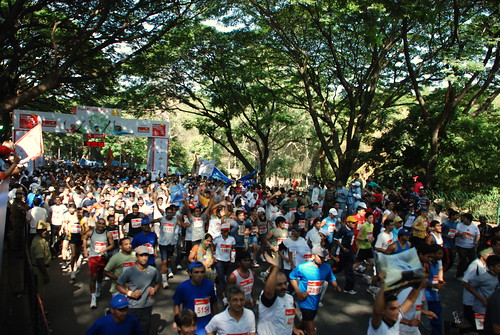
The event comprised of six races: World 10K Elite Men, World 10K Elite Women, Senior Citizens run (4 KM), Wheelchair event (4 KM), Open 10K Run and Majja Run (5.7 KM). Since the event was slotted between 6AM and 10:30AM, the city police authorities had made punctilious plans for minimal diversion of traffic during the four-hour marathon which saw active participation of around 20,000 people.

Namma Bengaluru

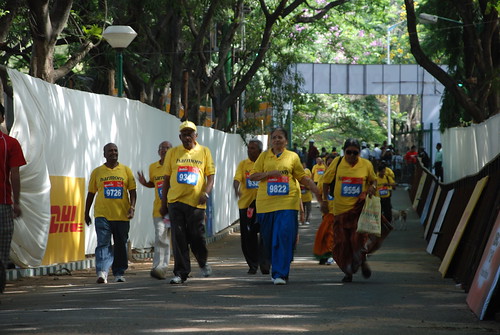
When I reached the spot around 7:30AM, preparations were in full swing for the Senior Citizens run which saw an impressive crowd of 700 plus participants. Most of senior citizens were aged above 60 but the energy and the exuberance that they displayed, quashed the roar of helicopters circling the stadium. Harmony, an NGO organized the senior citizens run. Each of the participants was given a T-shirt by Harmony and once they were dressed, there was a wave of uniformity at the starting point, very similar to a sight when children assemble in schools for morning prayer before classes commence. The highlight of this race was the high energy level of the senior citizens making them feel as if they were still in their teens. Jokes were cracked, few laughs were shared and there was an infectious air of camaraderie among these people who came not only from Bangalore but also from different parts of India.

Harmony Walk

Oprah Winfrey once said running is the greatest metaphor for life, because you get out of it what you put into it. This was the kind of perseverance exhibited by a group of steel-willed people. Braving the heat and the dust, the handicapped persons maneuvered their wheel chairs, reflecting the true spirit of participation.

Liveliness

Suddenly the action shifted to inside the stadium because the World 10K Elite Men/Women had entered the final stage. In a closely contested run, Zersenay Tadese of Eritrea bagged the 1,50,000 US Dollar Sunfeast World 10K title by completing the marathon in 27:51 seconds just three seconds ahead of his rival Moses Kipsiro of Uganda. The women’s section witnessed the rarest of rare photo finishes in any 10k run, with both Grace Momanyi of Kenya and Elevan Abeylegesse of Turkey, declared joint winners. The complete results can be seen here..

The final lap

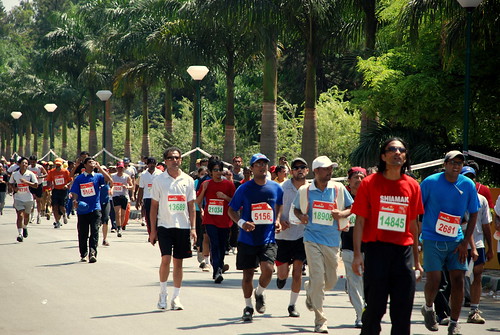
There was cut throat competition in the Open 10K run which had large groups of amateur runners, trying their level best to live up to their own expectations. Few ran, few jogged and rest others just walked in the spirit of sport.

Namma Bengaluru, Rocks !!!

Everyone was indeed up and running. It was a place where the east met the west while running.

Where east meets west

The most delightful aspect was to see each one run irrespective of caste, creed, color, religion, sex, age, language, region, etc.

Bangalore Sneaker Lovers

There was one single motive to be a part of the excitement and ebullience.

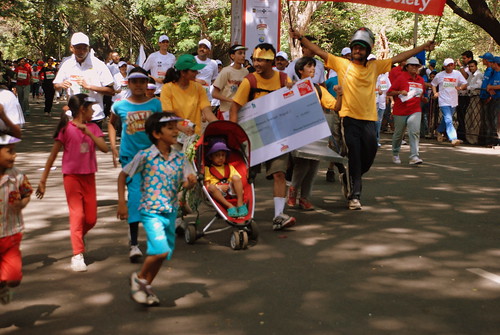
Even those in pram had fun time

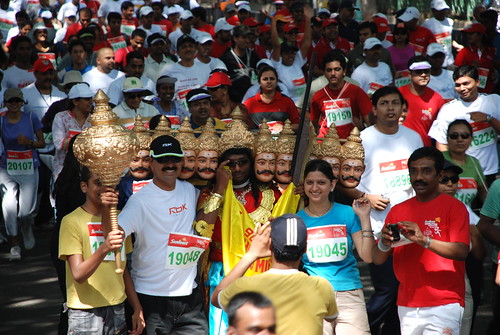
The Majja Run as the name signifies (majja means fun) merriment was the epicenter of frolic and liveliness. Though the distance to be covered for this particular race was only 5.7 kms, what separated this one from the others were the variety and the diversity. There were runners turning up in varied costumes with powerful messages, banners and placards.

Bums of the Saddle

Few celebrities like Dino Morea, Rahul Bose, Charu Sharma and Vijay Amritraj had the crowd screeching as they made their appearance for the Majja Run. Everything here resembled a mini-carnival and fancy dress competition. Girls with different attention-getting dresses very much like the Indianized version of IPL cheerleaders attire.

Indiatimes Team

Someone even put on special clothes to appear princely, like the mighty Tipu Sultan.

Maharaja Ke Jai Ho !!!

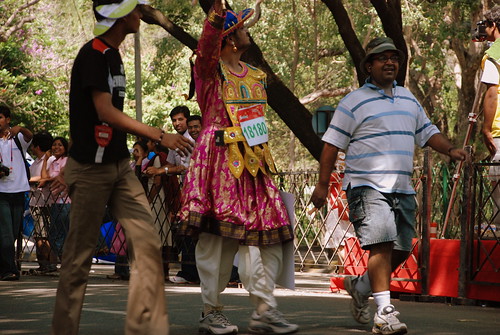
The one that surpassed every other costume in terms of ingenuity and colorations was the Ravana attire. Like a bee gets attracted towards nectar, participants were pulled in towards this individual dressed as Ravana to take a few snaps in the midst of the race.

Neo-age Ravana

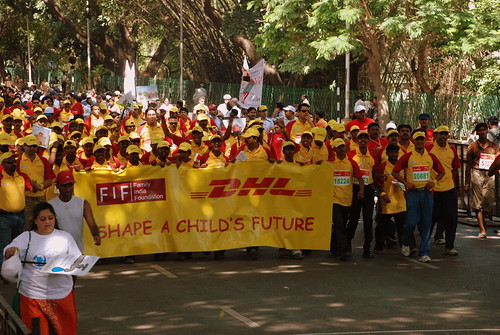
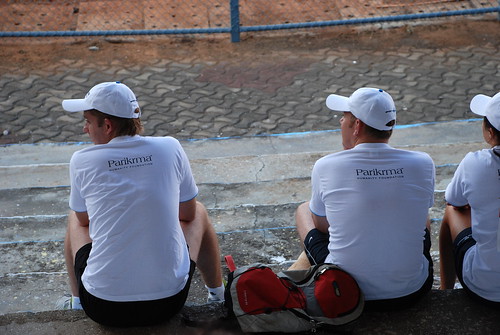
There were lots of groups and voluntary associations such as Parikrma, Harmony and others who all came under one umbrella 'Bangalore Cares'. This aggroup participated in the race for a number of causes such as children welfare, greener and pollution free Bangalore, togetherness, etc.

DHL : Shape a Child's Future

Team Parikrma: Sports for All

How can an event of such extensive magnitude and variety happen without the support from corporate and business sponsors and advertisers? Well of course there were some sponsors from a wide spectrum. DHL was the logistics partner and it participated in big numbers, with few of the team members having flown from Mumbai. To name a few, Nike was the running partner, Kingfisher, the airline partner, Radio Mirchi as the radio partner, Manipal Cure and Care, as the medical and health partner, etc who passionately supported the cause and diversity of the World 10K experience. CNBC-TV18 was media partner and it brought the event live to millions of Indians on that day, to the television sets from 7AM onwards, along with a potpourri of other coverages and programmes related to this the event.

CNBC Awaaz

Reporting Center for the World

All is all it was a well organized event that got equally receptive reactions from all those who participated for this run. This race put Bangalore in the map of conducting with dynamism and zings a global marathon. More so, it was a testimony to the fact that multiple goals can be achieved through sports and citizen's active participation and above all how sports are a social leveler.

Cheering Bangalore

In this huge ocean of human beings, I could see some human faces which pulled my attention like a magnet pulls pieces of iron. There was this elderly woman selling ground nuts who was a bit perplexed to see a sea of people just running, a very new site from what sees in her day to day life.

Why are all these people running ?

This man was also confused to see this sudden wave of sneaker lovers on an otherwise traffic struck road.

Aloneness

But one of the most satisfying moment in this entire event running with my camera was to capture this bubbly toddler, who had come with her dad and brother (if you can see, the young brother is just hidden from the father) to be a part of this race. She was giving poses which to me meant, 'Daddy isn't allowing me to run or crawl this year, well next year I would be there to tip toe with other people'. That's a smart and emotionally charged expression, so I and my fellow Bangaloreans would wait for you, sunshine girl, till we meet again.

Daddy I want to run too :)

The rest of the pictures are in this album. Naama Bengaluru rocks as always.

Keep reading and remain connected.

Labels: , , , , , , , , , , , ,

Monday, May 12, 2008

Who was she?...

Was Sa happy or was he chasing the rat race? Run, run and run and the road keeps extending. He doesn’t have a definite answer to this query but all he could say is that he was following a pattern, a pre-set societal blueprint. Every morning when he woke up, he used to think about the milestone that he had planned to reach, and late at night when he hit the bed, he used to do a catharsis of how close or how far he was from that destination.

Now if some sensible person asked Sa what he was after, he would struggle for a befitting reply, but all that mattered at that moment, clear like a crystal was to make it big, real big in life. He felt this 'real big' word was a bit deceptive. 'Real big' is like a mirage, the more nearer one goes, the farther the view range extends. Still there is a stage in life, when all these dichotomies just don’t matter much and there is one thing creeping in the mind. That one thing is some goal about which he knew but then again he didn't know.

Time passed by and the so did, Sa in his journey. He worked very hard, learned every trick in the trade. Soon he was walking, talking and behaving like one of those in the business circles, the 'in', 'with it' crowd. Everything he did was always pointed towards getting what he wanted, measured, calculated and assessed. It's not that success was his partner all the time, even the numerous lessons in failure alongside, made him worked harder. His career needle was accelerating northwards, with muddiness still sitting like a couch potato within him. He made lots of friends, who were always there in times of celebration and festivity but couldn't count on any when there was dark cloud over his ceiling.

The badges and emblems of worldly success were slowly getting into his bag. Everyday at around midnight, when he opened the door of the apartment, he was sure that he was getting one step closer to his target. He was not afraid of the loneliness that awaited him as he knew it was only for half a night, and then as morning drew close, he felt energized hoping that in a few hours he would be in his kingdom, with his rules of governance.

And then she came, to use a cliché, like a breath of fresh air after long gap. She was everything that he was not, she stood for everything that he did not, she believed in everything that he did not, she did everything that he did not.

She reminded Sa of the senior professor, who had assigned him with a bagful of responsibilities about a decade ago while he was an intern. Polite, poised, well-behaved, never loosing temper, accommodating, in short humility personified. These are a few commonalities that they shared, but there was a lot more to this remarkable woman. It was kind of a scenario in which one feels overloaded with words to express but you just can’t express. Heart in heart, there is a sudden flood of phrases, similar to the kind when water gushes when the dam gates are opened. She seemed too good to be real. Did he mention she was good? Maybe he was using that word because he was short of words as to how to describe her. Yes, she was good in the sense that she was good in what she believed in, stood for or did. And perhaps that was what made him like her, though he often found her beliefs unearthly, her attitudes and values outdated. Sa could not but admire the way she stood for them and acted on them and, yes, she was really good in that. She stood for 'what you preach is what you practice'.

Sa having come across a host of personalities in his work-circle somehow found her to be unreal. She did not behave like the people he interacted with or dealt with in his day-to-day life, and that really made him comfortable on the surface and uncomfortable in the interior.

She made all his years of bookish experience and knowledge feel like useless, though that was never her intention. That’s how Sa felt it, all acquired skills were just bi-sected and looked upon in a different angle. He was trained to always read between the lines, to study the body language, to know what a person really meant. He always tried to study the expression in the eyes, as they normally did not lie. He also developed the skill that enabled him to see through the veils of words spoken and signals sent. He was trained to differentiate between a genuine smile and a fake one. He learnt to gauge the degree of warmth in a person.

Did any book teach him that, nah nah never.

Everybody around Sa was an actor. Yes, they did show emotions, but everything was calculative. Every smile was calculated every tear was accounted for, every hug executed to enhance relationships, every handshake to convey messages. He was with everyone, but did not belong to anyone. Every relationship had its own value and place in the larger scheme of things and served some purpose or the other and always acted as a mean. Sa was not apologetic about this because everybody did it. That’s the way, life is modeled after in today’s age. Rather, that’s the only way Sa had seen the world so far.

And as Sa said at the very beginning, was he happy? Still no clues about that.

But, she changed all that. He tried to read between the lines, study the body language and always noticed for the eye movements; few were positive hits but every time he failed, he failed miserably. This irritated him, frustrated and angered him; Sa felt he was losing the edge, the ability to get through the veils of people, and that really was a scary thought. So, he tried harder since he never accepted defeat, he was not a loser. But, he failed time and again. But there are times in life, when even the taste of defeat brings comfort.

Her actions always matched the words she spoke, her smile was always genuine, and her hug was always full of warmth. But, how could this be true? How could a person live without pretending or shamming?

From the day she started living with him, his world turned upside down. He returned home early, yes it had become a home, it was not a house bordered by concrete walls anymore. Now, when he inserted the key, he knew there was someone to attend to him. He knew she genuinely cared for him. Her relationship was free flowing, because Sa was the end as well as the starting point for her. Her love for him was unconditional and unselfish and it did not have any ulterior motive, she loved him for what he was.

She cooked all his favorite dishes; she knew what he wants, when. She nurses him when he is ill, she takes him in her arms when he wants to cry (most often in the railway stations and airports before the final departure call) so that Sa feels secure. After so many years, he can laugh and cry when he wants to, not when others expect him to.

Sa is no longer a restless soul anymore. He doesn’t wake up everyday to run and remain ahead of the crowd. Yes, he still enjoys his work, but it is no more the centre point of his existence. There is a big world to explore, just that someone needs to provide one with the right lens to checkout the right colors. He does no longer want to achieve 'it' or reach 'there'. And yes, he is very happy, and this happiness is not a superficial, non-penetrating and deep, vacant feeling like it was earlier. Now his happiness does not need a measuring rod, is not linked to the things Sa is doing or achieving. This makes his new found happiness, complete, composite, stress-free and devoid of any pressure or worries. Yes, it is for real.

And, this has become possible because of her. Sa wonders how he managed all these years without her, after he left for his graduation school. He regrets not having her with him for so long. But, he is glad that he has her now and he wants to make up for all the lost time. He wants to tell her how much he loves her, how essential and integral she is to his existence, how meaningful she has made his life, and Sa wants to thank her for all the things she has done and keeps doing for him, for all the love she has given him, for the care and concern she has shown him and, most importantly, for always being there for him whenever he needs her.

That night after dinner, when she came and sat beside Sa, all he could do was look into her eyes and say, 'Maa, I love you.'

She took him in her arms, patted his back and said, 'Stupid, you need not say that. I know you love me.'
Happy Mother's Day.


Keep reading and remain connected.

(Note: The pic in this post is by David Zimmerly, an anthropologist and world traveler.)

Labels: , , , , , ,

Friday, March 21, 2008

Each Face has a story...

In my occasional travels to the hinterland, I have noticed that the many of these places differ radically from each other but most seem to offer something new to learn and taste some new colors. Through my lens, I tried to capture few of these effective representatives of raw beauty of that society.

In most cases here, the simplicity of the subject is directly proportional to the sophistication of the output that one gets from the click. In one of my posts, temporal had left a comment:

would love to see "portraits"

without flash, of course...in natural light and shades the faces tell stories that words fail to capture (mostly)

I fully agree to each and every word in that statement by temporal, that the cloud of raw emotions do convey a story that words fail to capture.

The facial gesture reminds me that nothing is concealed.

Nothing is concealed

Some eloquent silences but even this silence offers soothing words of warmness.

Grand Ma

His face is a palette of light, a landscape that offers one to see the geometry of everyday life in the barest form.

Palette of Light

The inelastic and expressive wrinkles echoed and re-echoed, a motley of emotions. Like in this case, it sends a mixed message, stewing in silence.

Inelastic and expressive wrinkles

He seems blate, almost shy. His expressions evoke an intimate, possibly wordless, dialogue.

Like his shyish smile

He is looking right into my camera, his turbaned head tilted a bit, but his eyes and the white beard catch the light and lens just so, revealing something of a soulful vulnerability and thoughtfulness. An obvious mix of tension and diffused graceful touch.

Thoughtfulness

Just as each wrinkle of an old moccasin reveals a story about the foot that wore it, this grandma like figure's smiley face with the stark features convey a fascinating wordless tale.

Smiley face

He comes close in this picture to perceive, what is behind the mask of the face, that spark and glow of life? I feel its satisfaction and the maturity that flows fluidly back and forth.

That spark and glow of life

Lost in thoughts, there is a kind of loneliness, a sadness in his eyes as the trails of smoke from his beedi, perfects his mood.

Lost in thoughts
Talking to these people, thorough the lens is also like working to untangle fragments of personalities. Waiting lounges in airports, a gathering near a chai shop, the city markets, etc always tease with the promise of a story the viewer of these urges to be told. The frames always offer something new and entice one to come back again.

Keep reading and remain connected.

Labels: , , , , , ,

Sunday, February 17, 2008

Have you been here ?...

A couple of days back, BD had chronicled his experience of having dosa with his family at a classy restaurant in Lucknow. (This part is a bit off-track from the post and I learnt about this from a recent read, 'Umrao Jan Ada' by Mirza Hadi Ruswa. Asaf-ud Daula, the successor to Shuja-ud Daula had moved the capital to a site on the river Gomti which according to some was known as Lakshman Tila meaning 'The Mound of Lakshman', the younger brother of Lord Rama. With time, the Sanskrit name Lakshman developed into Lakhnau, spelt in English as Lucknow. So that's the genesis of the name of a colorful city, Lucknow.)

Smallsquirrel posted a comment on BD's yummylicous post:

I must say, though, that I prefer my dosas from the itty bitty darshini down the street, eaten standing next to my neighbors and assorted rickshaw wallahs, and washing it all down with a cup of steaming filter coffee (which only tastes good when made from packet milk and not that hyper-pasteurized stuff in tetrapacks found at five star joints).

I say this not because I scoff at 5 star hotels (who does not love a bit of luxury) but because the dosas at these places are always a lot nicer somehow... the potato palya is spicier, the chutney is more flavorful, the dosa more crisp...

don't you think?

Yes, I do. One needs to be in a place commonly known as V.V. Puram, Food Street or V.B. Bakery Road to Bangaloreans, a street that has its own tenuities, and its own history. In a city, which is today witnessing a growth rate of close to 10% and is home to almost all global brands even in the food segment, this street still offers something that sets one salivating.

The Full list

Come twilight, the air is charged with the scent of jasmine, unnoticeably blended with the fragrance of jalebis, pav bhaji, akki roti, masala dosa, gulab jamoon, potato bonda, American baby corn and a host of other mouth watery eatables.

Rabadi

The akki roti served with a spoonful of butter on top along with different types of chutneys such as coconut, onion, and chilli is a must eat for any visitor. There are a number of dosa joints that dot this 150 meter long street and the variety of dosas range from the simple plain dosa to the foot-long paper masala dosa served with fresh coconut and onion chutneys. The most striking feature is there is no sitting arrangement and in most places, paper cones, paper plates or plantain leaves are used to serve food. There is never any wastage and invariably every bit is literally licked till the last morsel. Also, the food stall owner makes food right in front of you, typifying the 'WYSIWYG' format (what-you-see-is-what-you-get). I found that these chaps do not compromise on quality as most of the stall owners of dosa were using 'Nandini' ghee, (the brand/make that is used in most households in Bangalore) to embrocate the dosa.

Yummy Dosa

How can you be here and miss the bondas, which are generally made of potato, chilli, capsicum, and banana. One can see, hear, and smell whatever was happening in the kitchen, wherefrom a constant traffic of trays loaded with garam garam jalebis passed on to the front counter.

Jalebis

As long as there is frying, serving, and sizzling noise in the kitchen, with trays and plates leaping across counters and various hands, it means the the action is on. The street starts welcoming the clientele at around 6:30 P.M and the process continues till 10:30 P.M.

Concentration

The taste of each of these edibles is difficult to reproduce at home. The reason for this is simple, for ages, the deft and magical fingers of these vendors have mastered the art of deciding the quantity of salt, or ghee or for that matter any ingredient that must be added to satisfy their customers, the simplest way. The skill and precision with which the Puran Poli, a sweetened stuffed chapatti is fried on a hot tawa (frying pan), then taking the Poli out from the pan at the right moment, and serving with a dollop of ghee is not only a spectacle to watch but also a teaser to taste buds.

Pooli

But places like these are slowly fading and evanescing. Maybe this is because the present young generation’s tastes are changing and everyone wants to identify oneself with the mall culture that is dispersing at a fast pace. But trust me, if you want something simple and want to see the colors of life, places like Food Street at V.V.Puram are a must to visit. Parking becomes a bit painstaking during the rush hours of business, but it's manageable. Also make sure that you have lot of denomination of Rs.5 and Rs.10 in your wallet when you visit this place. Why do I say so? Be there and you can know it yourself.

Price List

This place is very near to Lal Bagh West Gate.

Keep reading and remain connected.

(Note: That the gentleman who prepared the foot-long dosa that you see in the pic, didn't charge me a single penny because he liked the pic that I took for him. I requested him and told him that this was not fair as he deserved his due, but he smiled and asked if he could meddle with my camera for a while. So this post is for that humble soul.)

Labels: , , , , , ,