Tuesday, February 24, 2009

Mark Tully's, The Heart of India...

A couple of days back, the news of Chander Mohan, son of Haryana's seasoned politician Bhajan Lal getting himself converted to Islam, with a new name Chand Mohammed was the talk of the town. The conversion was apparently not because of Chander Mohan's strong faith but for getting married for the second time to his lady love, lawyer and former Assistant Advocate General, Anuradha Bali, who also got converted to Islam, to be reborn as Fiza.

Don't you feel that this incident had all the ingredients of a Bollywood potboiler and even beyond?

Also a couple of weeks back, while reading the newspaper, I learnt about a spine-chilling incident, in which a mother, wanting to fulfill her religious vow, dipped her three-month-old baby three times into a boiling rice pot in Jumalapur village in Bijapur district. It does sound scary, something like the ripley-believe-it-or-not kind of act.

But why am I talking all these, when incidents such as these and many more occur in abundance in India day in day out. We are sort of used to it. Few of these find coverage in the media and few do not depending on the location of the events and also on the accessibility and penetration factor for media coverage. But incidents such as these are a part and parcel of life in this colorful nation and that’s exactly what Mark Tully, has covered in his book, 'The Heart of India'. I completed reading the book which is full of color, noise and scent, akin to desi lifestyle.

Mark Tully needs no introduction, for he is well known for covering many major incidents in South Asia during his tenure as a reporter. What sets him apart from other reporters is his deep involvement in the tinges of this land, his genuine love and in-depth, innate understanding of India's psyche. 'The Heart of India' is a not a coffee book of Indian hinterland but rather it delves sensitively into the nuances and shades of everyday life in villages of the northeast states of Bihar and Uttar Pradesh. The author writes in the preface part of the book that he chose this region of India because it has remained largely unaltered from ancient times and also for the fact that, Hindi is widely spoken in that belt and he is quite comfortable with the language. Time and tides have come and gone, but this region has not changed much.

Tully has also mentioned that most of the chronicles, are true but he has tampered those a bit here and there to add an element of imagination and fiction. The stories revolve around the social requirements of childbearing and how a barren lady conceives after a visit to a holy man, the false superbia that is attached to the Indian caste system and the toxic syrup that is drunk in regular dosages to keep the engine of administration moving both at the local bodies and the state level, corruption. The writing is soaking because, Tully doesn't swim at the surface level, rather he dives into the ground level writing with great detail about the degrees of gossip, ghar ghar ki kahani and the lack of privacy in village life. In one of the tales, he tells about the erosion of the old rural India, by the careless rush towards modernization through the lens of an old Muslim ikkab-puller who owns a dilapidated horse-carriage, a vehicle which has turned unserviceable in an age of auto-rickshaws. In another, he narrates the story of Madhu, who leaves her village to do a B.Ed degree at the famous BHU, becomes an active participant in college politics, falls in love and then life takes a never anticipated turn as her romance ends in blackmail. A tale of reality check, of a life hedged with numerous limitations. He also examines how the people have tagged many things in the name of religion, while they are in a state of disarray or confusion when it comes to differentiating between ritual and reality. Tully's unhesitating assumption of his characters illustrates life as it is, in a heartfelt manner. It's not like he wishes to show the good side and cover up the not-so-good side. The stories don't paint an idyllic picture.

The book gives the feeling of a letter written by someone while traveling in a 2nd class sleeper compartment of Indian railways, drinking chai with the sight of Indian hinterland dancing in a graceful and rhythmical way in the window frames. I also felt that, Tully has listed in a subtle way the obstacles that India has to overcome in its march towards attaining the status of economic powerhouse.

This book may not be one of the finest of Tully's creations (my perception though), but definitely it gives a vivid and true portraiture of village life. It also educates those, who grew up in cities within India and outside, and are a bit cut off from the ground realities about India's complex social, cultural and political matrix that persist even after we have undergone a dramatic change from a third world country to under developed nation to a developing economy.

Keep reading and remain connected.

Labels: , , , , ,

Monday, May 12, 2008

Who was she?...

Was Sa happy or was he chasing the rat race? Run, run and run and the road keeps extending. He doesn’t have a definite answer to this query but all he could say is that he was following a pattern, a pre-set societal blueprint. Every morning when he woke up, he used to think about the milestone that he had planned to reach, and late at night when he hit the bed, he used to do a catharsis of how close or how far he was from that destination.

Now if some sensible person asked Sa what he was after, he would struggle for a befitting reply, but all that mattered at that moment, clear like a crystal was to make it big, real big in life. He felt this 'real big' word was a bit deceptive. 'Real big' is like a mirage, the more nearer one goes, the farther the view range extends. Still there is a stage in life, when all these dichotomies just don’t matter much and there is one thing creeping in the mind. That one thing is some goal about which he knew but then again he didn't know.

Time passed by and the so did, Sa in his journey. He worked very hard, learned every trick in the trade. Soon he was walking, talking and behaving like one of those in the business circles, the 'in', 'with it' crowd. Everything he did was always pointed towards getting what he wanted, measured, calculated and assessed. It's not that success was his partner all the time, even the numerous lessons in failure alongside, made him worked harder. His career needle was accelerating northwards, with muddiness still sitting like a couch potato within him. He made lots of friends, who were always there in times of celebration and festivity but couldn't count on any when there was dark cloud over his ceiling.

The badges and emblems of worldly success were slowly getting into his bag. Everyday at around midnight, when he opened the door of the apartment, he was sure that he was getting one step closer to his target. He was not afraid of the loneliness that awaited him as he knew it was only for half a night, and then as morning drew close, he felt energized hoping that in a few hours he would be in his kingdom, with his rules of governance.

And then she came, to use a cliché, like a breath of fresh air after long gap. She was everything that he was not, she stood for everything that he did not, she believed in everything that he did not, she did everything that he did not.

She reminded Sa of the senior professor, who had assigned him with a bagful of responsibilities about a decade ago while he was an intern. Polite, poised, well-behaved, never loosing temper, accommodating, in short humility personified. These are a few commonalities that they shared, but there was a lot more to this remarkable woman. It was kind of a scenario in which one feels overloaded with words to express but you just can’t express. Heart in heart, there is a sudden flood of phrases, similar to the kind when water gushes when the dam gates are opened. She seemed too good to be real. Did he mention she was good? Maybe he was using that word because he was short of words as to how to describe her. Yes, she was good in the sense that she was good in what she believed in, stood for or did. And perhaps that was what made him like her, though he often found her beliefs unearthly, her attitudes and values outdated. Sa could not but admire the way she stood for them and acted on them and, yes, she was really good in that. She stood for 'what you preach is what you practice'.

Sa having come across a host of personalities in his work-circle somehow found her to be unreal. She did not behave like the people he interacted with or dealt with in his day-to-day life, and that really made him comfortable on the surface and uncomfortable in the interior.

She made all his years of bookish experience and knowledge feel like useless, though that was never her intention. That’s how Sa felt it, all acquired skills were just bi-sected and looked upon in a different angle. He was trained to always read between the lines, to study the body language, to know what a person really meant. He always tried to study the expression in the eyes, as they normally did not lie. He also developed the skill that enabled him to see through the veils of words spoken and signals sent. He was trained to differentiate between a genuine smile and a fake one. He learnt to gauge the degree of warmth in a person.

Did any book teach him that, nah nah never.

Everybody around Sa was an actor. Yes, they did show emotions, but everything was calculative. Every smile was calculated every tear was accounted for, every hug executed to enhance relationships, every handshake to convey messages. He was with everyone, but did not belong to anyone. Every relationship had its own value and place in the larger scheme of things and served some purpose or the other and always acted as a mean. Sa was not apologetic about this because everybody did it. That’s the way, life is modeled after in today’s age. Rather, that’s the only way Sa had seen the world so far.

And as Sa said at the very beginning, was he happy? Still no clues about that.

But, she changed all that. He tried to read between the lines, study the body language and always noticed for the eye movements; few were positive hits but every time he failed, he failed miserably. This irritated him, frustrated and angered him; Sa felt he was losing the edge, the ability to get through the veils of people, and that really was a scary thought. So, he tried harder since he never accepted defeat, he was not a loser. But, he failed time and again. But there are times in life, when even the taste of defeat brings comfort.

Her actions always matched the words she spoke, her smile was always genuine, and her hug was always full of warmth. But, how could this be true? How could a person live without pretending or shamming?

From the day she started living with him, his world turned upside down. He returned home early, yes it had become a home, it was not a house bordered by concrete walls anymore. Now, when he inserted the key, he knew there was someone to attend to him. He knew she genuinely cared for him. Her relationship was free flowing, because Sa was the end as well as the starting point for her. Her love for him was unconditional and unselfish and it did not have any ulterior motive, she loved him for what he was.

She cooked all his favorite dishes; she knew what he wants, when. She nurses him when he is ill, she takes him in her arms when he wants to cry (most often in the railway stations and airports before the final departure call) so that Sa feels secure. After so many years, he can laugh and cry when he wants to, not when others expect him to.

Sa is no longer a restless soul anymore. He doesn’t wake up everyday to run and remain ahead of the crowd. Yes, he still enjoys his work, but it is no more the centre point of his existence. There is a big world to explore, just that someone needs to provide one with the right lens to checkout the right colors. He does no longer want to achieve 'it' or reach 'there'. And yes, he is very happy, and this happiness is not a superficial, non-penetrating and deep, vacant feeling like it was earlier. Now his happiness does not need a measuring rod, is not linked to the things Sa is doing or achieving. This makes his new found happiness, complete, composite, stress-free and devoid of any pressure or worries. Yes, it is for real.

And, this has become possible because of her. Sa wonders how he managed all these years without her, after he left for his graduation school. He regrets not having her with him for so long. But, he is glad that he has her now and he wants to make up for all the lost time. He wants to tell her how much he loves her, how essential and integral she is to his existence, how meaningful she has made his life, and Sa wants to thank her for all the things she has done and keeps doing for him, for all the love she has given him, for the care and concern she has shown him and, most importantly, for always being there for him whenever he needs her.

That night after dinner, when she came and sat beside Sa, all he could do was look into her eyes and say, 'Maa, I love you.'

She took him in her arms, patted his back and said, 'Stupid, you need not say that. I know you love me.'
Happy Mother's Day.


Keep reading and remain connected.

(Note: The pic in this post is by David Zimmerly, an anthropologist and world traveler.)

Labels: , , , , , ,

Monday, January 07, 2008

An Unsung Hero : Girish Bharadwaj...

In India, when we browse the newspapers these days, we read volumes about the story of 'digital divide' and how many of the telecom vendors and other entities are attempting to bridge this gap. To me, to be connected with the outside world, comes in the second level of requirement, after the core essentials for the proper functioning of a developing society are met.

The luxuriant Western Ghats kissing the borders of Karnataka and Kerala are a fascinating series of greenery dotted with hills and valleys, simple people, countless rivers and loads of freshness. Traveling across this stretch in the Indian Railways is the best way to soak oneself with the flourishing vegetation. To an occasional visitor, all these appear charming, a perfect way to break free from the randomness of city life. But come rainy season, this region is completely cut from the outside world, a place where people use boats or coracles in their daily lives to commute and to transport kids to the schools across the water bodies.

Living in cities and towns, we are tuned to getting all the facilities to reach our offices, schools, banks or for that matter any destination at any time of the day. Now think of a scenario in a village where the boats are the only savoir, and with the overflowing river during the monsoons, most boatmen are reluctant to ferry their boats. Life would come to a standstill, kids can't go to schools in time, pregnant ladies needing medication in the middle of the night can't be transported to the nearby hospitals and the problem list becomes endless.

But there is this unsung hero who with his engineering skills and humanistic activities has brought smiles and cheer in the faces of many people. This is Girish Bharadwaj, who hails from a small village Arambur, in Aletty district near Sullia town on the western slopes of Kodagu. Born in Mangalore in 1950, this virtuoso received his formal education from P.E.S. College of Engineering in Mandya near Bangalore. He learnt the classical techniques in Mechanical Engineering, during the 1970's, a time when not much stress was laid on experimentation but rather on the application part of it. During those days, getting a job was considered a remarkable achievement, and Girish took up a part time job while running Ayas Shilpa (sculpture in steel), a small fabrication unit in Sullia town.

It was in 1988, that Girish's career took a dramatic turn, when few people from his native approached him and requested him to build a bridge. Girish replied that since he was Mechanical Engineer and was not at all adept in Civil Engineering and construction related designs, he was not qualified for the assignment. But persistence, tenacity and the people's faith in him, triggered an unusual fire within him and he started studying about bridges. He consulted the technical faculty at two of the top technical institutions in India, National Institute of Technology, Surathkal and Indian Institute of Technology, Chennai and thus started his journey.

Today at the age of 58, Girish is the proud architect and constructor of close to 68 bridges in the deep hinterland, the average length of most bridges being 70 to 80 meters. The skeptics who had the impression that bridges, cannot stand without the pillars in difficult terrain, are speechless today with his marvelous creations, the suspension bridges.

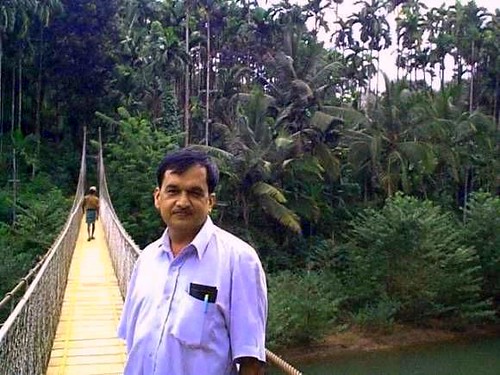
bharadwaj_1

I know Girish for a while now and after interacting with him, he shared with me few other facets of his artistry.

Initially big trees were used as pylons, if those were available at the right place as in case of Kodagu district. The trees were the perfect fits, when the bridges stretched from 10 to 30 meters. Concrete pylons are now preferred for longer stretches because of their assured long life. The hanging floor element is quite stable supported by anchors and transoms. On both sides of the bridge, PVC coated chain-link fencing is erected till waist level. Over the years, the bridges have seen many conceptions and engineering innovations.

Girish is supported in his work by a team of 36 members, of which 18 perform the core design and implementation tasks. Since there is no other organized body in India, which is consistently building hanging bridges at a low cost, with uncompromising importance to safety and quality, Girish has to yield to pressures now and then. I learnt that very recently he has got invitations from Srinagar in Jammu and Kashmir and Bhavnagar in Gujarat to undertake some new initiatives in those lands.

Because of various reasons such as distance to commute from Karnataka and to adjust in these new lands with different climatic conditions, lack of a skilled team to backup his core team members who are getting old, Girish is more than willing to share his knowledge and know-how's to interested people. He told me that all he needed were a dedicated engineer and a bunch of smart working boys and he would accompany and guide them till the completion of two or three bridges in a new region. Thereafter, the new team can carry on this task all by itself.

Girish, a father himself never pressurized his own children to carry on this tradition, and he is scouting for people interested to perfect the craft and utilize this workmanship for the benefit of the people and society. Although Girish, has not been advertised in the print and the online media much, he has found himself admirers from far and wide like Sri Lanka, Switzerland, Cambodia, etc.

Girish's people-based approach towards his work has always attracted considerable local support and it is very practical. When construction is in progress, his entire team, lives in small tents constructed on the river bed. They share the work and the food, concentrating till the project gets over. Girish recently completed a project in the naxalite terror afflicted, Warangal district in a placed called Laknawaram in Andhra Pradesh. He told me that, at night the common villagers used to come and share the tent with his entire team, providing the much needed security more out of thankfulness and appreciation, rather than his personal petition.

Trifle makes perfection but perfection is not a trifle, these words of wisdom apply to this master artisan who has lived his life bringing goodwill to millions of hearts. A rare individual to find in this bribe hungry bureaucratic world, not bothered about the felicitations, and all that drives him in his selfless endeavor is the gratitude and the warm blessings of the people.

Girish Bharadwaj's story is informative for those uninformed of India's social dynamics and wish to bring about a change by engaging in action-less dialogues and debates in television channels. Much of the exclusive economic growth and development is centered around urban areas and most of us in these concrete jungles, do not have enough time and energy for making a change in the bowels of India. But that hasn't stopped few humble folks from exploring ideas and gathering a core of dedicated people around their passion. Isn't that a miracle ?

Keep reading and remain connected.

(Note: Incase any reader is interested to interact with Girish and wish to learn more about his work, do drop me an email, (its there on my profile) to collect the contact and email details. Doing this to avoid misuse of the contact number and email account with unwanted calls and spam mails.)

Labels: , , , , , , , , , ,

Monday, December 17, 2007

A Rare School Shooting...

Since the time, you and I were kids, we have always considered school as a center of knowledge, a place of learning prefatorial and rudimentary manners of any genteel society. Add to this, it is a place that is always marked by childish mischief and gumptious cacophonies of students as they run aimlessly looking for their friends.

But this air of ingenuousness was punctured last week in one of most unimaginable act of juvenile delinquency. In what could be mentioned as one of the worst nightmares that any parent could think of, in a swish, upscale private school, 'The Euro International School' in Gurgaon, one of India's flourishing outsourcing hubs on the outskirts of Delhi, a murder happened in the the broad day light.

Abhishek Tyagi, a VIII class student of a school in Gurgaon, was shot dead by two of his classmates after school hours within the school premises. The reason was a simmering feud among Abhishek and two other students, a couple of days back and the end result of that disagreement was this shootout.

When one reads this news, the first thing in the morning on the breakfast table, it sends a chill down the spine. The most disturbing element being the type of violence happening in schools among the young ones. Bloodstains on the corridors of schools, were incidents that were typical to the western world but now it has happened in India. It abruptly throws before us, a bagful of questions. We all know that change is generally incremental in nature but sometimes things change so fast that it makes us think. What changed in the society that enabled these students to act and behave in a manner that was totally unexpected?

A simple evaluation of this incident tells that both the accused boys involved in the shooting hail from upper middle class families whose fathers dealt with the complex world of real estate business. The world real estate is tinctured with its own set of conventions, the more one enters into the intricacies of this business, the more insecure and worn-out life becomes. In India, ten years ago, very few people had access to guns for personal protection because of the difficult gun license policies. Times have changed now, with oodles of disposal income and with an intention of personal protection, the nouveau rich business men can easily own a gun.
'He took out his father's revolver from the TV trolley and smuggled it to the school concealed in his socks. He then hid the gun in the bathroom waiting for the school to get over and then fired at Abhishek,' said Mahender Pal Singh, Police Commissioner, Gurgaon.

What is really disturbing in this episode is that, the father of one of the accused leaves the revolver in the TV trolley as if it's a toy or a remote control that can be picked up and used by anyone. The father was definitely aware of his negligence in handling the firearm; else he would not have been absconding after the gruesome incident, only to have surrendered four days later.

Many people commented that, we Indians are slowly importing these kinds of mannerisms from the western world. Watching movies packaged with violent scenes and enjoying virtual games on the computer or the internet are often cited as reasons that induce rashness and recklessness in a child’s behavior. I don't buy and accept this accusation or statement in totality. It's not that I am supporting the West, but let's not get into the blame games when there are certain tangible fractures in the new Indian socio-eco system, especially in the cities and metropolis. I believe that that learning the right values is not a matter of geography but what we see around us and the way we are nurtured to handle things and situations.

The present day India is swamped by crass consumerism and rat race for acquisition of commodities of materialistic value. Many people are part of this never ending marathon, which leaves them with little energy and time at the end of the day for their children. At the growing age, children are like flexible clay, so their whippy minds can be modeled with ease. In my view, which ever part of the world one goes, children are always children; they are reflections of societal and parental values. A simple nourishing value system and strong parental involvement in this changing world are something those that are needed.

Do you feel that children would enjoy their school life under the surveillance of CCTV and metal detectors? One of my friends, Deepti poses many such questions in her post here.
The school has cameras fitted in and now the parents are demanding metal detectors. Whats happening in our schools? Where is all this anger coming from? Is it time for parents to think of home schooling? Or turn schools into prisons?

How can we protect our children from their own classmates?
Keep reading and remain connected.

(These views are mine and are not quoted at any individual.)

Labels: , , , , ,